

A dog collar is most commonly called a dog collar, or simply a collar when the context is clear. Depending on its design, you may also see terms such as Dog Neck Collar, Pet Collars, Flat Dog Collar, Martingale Collar, tactical collar, buckle collar, reflective collar, or personalized collar.
Although these names are related, they do not always describe the same product. For example, a Flat Dog Collar is the conventional adjustable design used for identification and everyday walking, whereas a Martingale Collar adds a limited-slip section intended to reduce the chance of a dog backing out when correctly fitted.
For pet owners, understanding these names makes shopping easier. Meanwhile, brands, distributors, and wholesalers also benefit from using accurate terminology because different Dog Collars may require different materials, hardware, sizing systems, sewing methods, and quality-control standards.
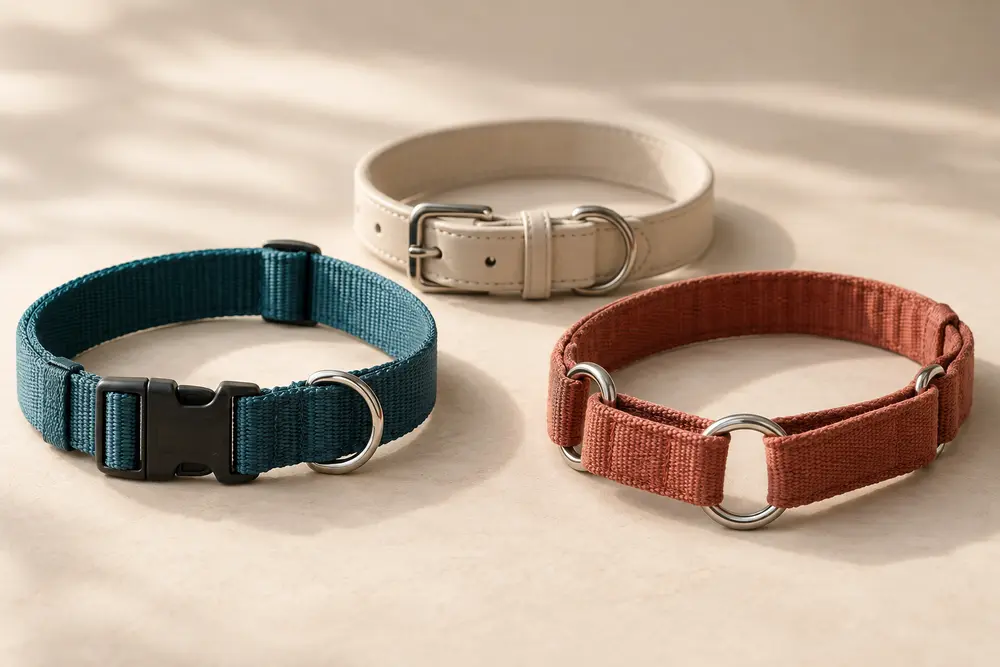
What Is the Proper Name for a Dog Collar?
The standard English term is dog collar. In normal conversation, people usually shorten this to “collar” once it is already clear they are talking about a dog.
Dog Neck Collar is also understandable, especially in online searches and international sourcing. However, “dog collar” remains the more natural product name in everyday English.
By comparison, Pet Collars is a broader commercial term. It may include collars for dogs, cats, and other companion animals. Therefore, a supplier advertising Pet Collars may offer several product categories instead of dog products alone.
Dog Collar
The standard general term for a collar designed to be worn around a dog’s neck.
Dog Neck Collar
This descriptive alternative is commonly understood in product searches and B2B sourcing.
Pet Collars
This broader commercial category can include collars for dogs and other companion animals.
Flat Dog Collar
This conventional adjustable style maintains a relatively fixed circumference after adjustment.
Martingale Collar
This limited-slip design contains an additional control loop that changes the effective circumference.
What Are the Different Types of Dog Collars Called?
Dog Collars are usually named according to their structure, closure system, materials, or intended application. Therefore, the product name often provides useful information about how the collar is constructed and where it is intended to be used.
Flat Dog Collar
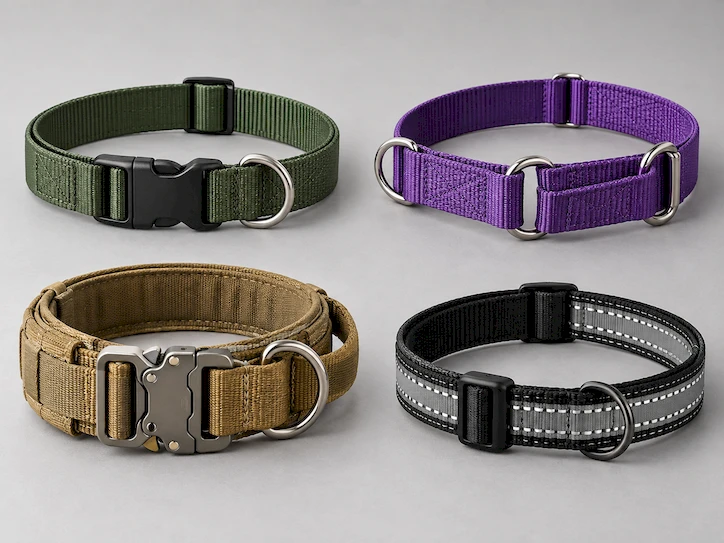
A Flat Dog Collar is probably what most people imagine when they hear “dog collar.” Its basic structure normally includes webbing, a buckle, an adjustment slider, a D-ring, and reinforced stitching.
Because of its simple structure, this style is widely used for identification and everyday walking. In addition, it is one of the most common starting points for private-label Dog Collar collections.
The American Kennel Club describes flat-clip and buckle collars as widely available collar styles and notes their usefulness for holding identification tags.
Martingale Collar
A Martingale Collar is also commonly called a limited-slip collar. Rather than maintaining exactly the same circumference, it contains an additional loop that reduces the effective circumference when leash tension is applied.
VCA Animal Hospitals explains that this type of construction may help reduce escape risk compared with an ordinary buckle collar when it is fitted correctly. However, poor fitting can cause discomfort or create entanglement risks.
Buckle Dog Collar
A buckle collar is named after its closure system. Common options include plastic side-release buckles, acetal buckles, traditional belt-style closures, zinc-alloy hardware, and aluminum-alloy buckles.
As a result, the selected buckle can influence product weight, appearance, manufacturing cost, assembly method, and the overall design language of the finished collar.
Tactical Dog Collar
Tactical collars are generally heavier and more structured than basic Pet Collars. Depending on the design, they may use approximately 38–50 mm webbing, reinforced stitching, metal hardware, grab handles, hook-and-loop panels, and identification patches.
However, “tactical” is a product category rather than one universal engineering standard. For this reason, wholesalers should compare actual webbing, hardware, stitching, dimensions, and test requirements instead of relying only on the tactical label.
Reflective Dog Collar
A reflective dog collar incorporates reflective yarn, strips, piping, or printed elements. Consequently, these products are often developed for evening walking, outdoor use, and visibility-focused dog walking gear collections.
Personalized Dog Collar
Personalized Dog Collars may include a pet’s name, contact information, decorative artwork, or commercial branding. For example, common options include embroidery, printing, woven labels, silicone logos, rubber patches, engraved buckles, and metal nameplates.
How Tight Should a Dog Neck Collar Be?
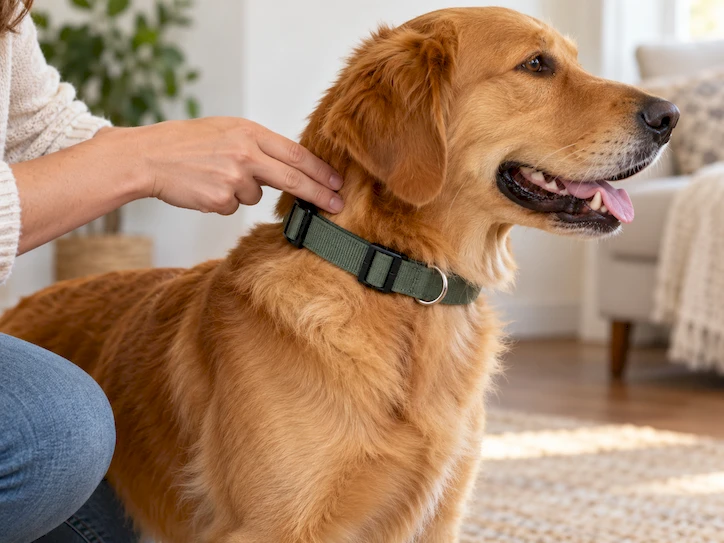
Fit is one of the most common areas where collar users make mistakes. A widely used practical guideline is the two-finger rule: there should generally be enough room to fit two fingers between the collar and the dog’s neck.
The American Kennel Club recommends measuring the dog’s neck rather than relying only on breed or generic S, M, and L labels. In addition, it recommends measuring while the dog is standing.
Similarly, the RSPCA recommends leaving approximately two fingers of space between the collar and the dog’s neck.
The two-finger rule is a practical fitting guide rather than a manufacturing specification. Therefore, OEM production should use actual neck circumference and adjustment range in centimeters or millimeters.
Real-World Mistake: Choosing a Collar by Breed Instead of Neck Size
A common assumption is, “My dog is a Labrador, so a Large collar should fit.” In practice, that shortcut is unreliable.
Two dogs of the same breed may have noticeably different neck circumferences because of age, sex, genetics, body condition, coat thickness, and grooming. Moreover, the same dog may need a different adjustment after weight changes or grooming.
For this reason, brands should publish actual adjustment ranges instead of relying only on size names.
| Size | Example Adjustable Neck Range | Example Webbing Width |
|---|---|---|
| XS | 20–30 cm | 10–15 mm |
| S | 25–40 cm | 15–20 mm |
| M | 35–50 cm | 20–25 mm |
| L | 45–65 cm | 25–38 mm |
| XL | 55–75 cm | 38–50 mm |
These ranges are examples for product development, not universal dog collar sizing standards.
What Does Published Testing Tell Us About Dog Collar Pressure?
Dog Collars look simple, but their mechanical behavior is not. More importantly, published veterinary research shows that collar design and leash force can significantly affect pressure applied around the neck.
Seven Collars and One Slip Lead Tested
A 2020 study published in Veterinary Record tested seven collars and one slip lead on a simulated canine neck.
During the experiment, researchers applied three leash-force conditions:
Measured pressure ranged from approximately 83 kPa to 832 kPa, depending on collar type and the applied force. Furthermore, the researchers found statistically significant effects from both collar design and leash force.
Because the experiment used a simulated neck rather than a living dog, the numbers should not be interpreted as the pressure every dog experiences during normal walking. Nevertheless, the results clearly demonstrate that collar geometry and applied force matter.
Padding Does Not Automatically Mean Lower Pressure
Another experiment tested three equally sized collar constructions on eight dogs: a double-layer polyester/nylon collar, a single-layer nylon collar, and a single-layer canvas collar.
The researchers used a Tekscan pressure-sensing system and reported an average overall peak force of 30.2 N. Interestingly, the double-layer polyester/nylon construction produced significantly higher peak force and contact pressure in some comparisons.
Manufacturing Takeaway
Adding more padding does not automatically guarantee lower peak pressure. Instead, brands should also evaluate padding coverage, transition points, foam density, compression, webbing width, seam thickness, and hardware position.
Real-World Mistake: Assuming a Wider or Padded Collar Is Always Better
A buyer may ask a factory to “add 5 mm of padding and make the collar softer.” At first, this sounds like a simple improvement.
However, extra padding can reduce usable adjustment range, increase finished thickness, affect buckle compatibility, change folding dimensions, and alter collar geometry. Therefore, an OEM manufacturer should remeasure and re-evaluate the prototype after material changes rather than simply inserting more foam into the original pattern.
Dog Collar vs. Harness: What Is the Difference?
A collar and harness distribute leash forces differently. A Flat Dog Collar mainly contacts the neck, whereas a harness distributes force across a larger part of the chest and torso.
| Feature | Flat Dog Collar | Dog Harness |
|---|---|---|
| Main contact area | Neck | Chest and torso |
| ID tag attachment | Very convenient | Depends on design |
| Construction complexity | Relatively low | Higher |
| Material consumption | Lower | Higher |
| Adjustment points | Usually one | Often two or more |
| Typical weight | Lower | Higher |
| Branding area | Moderate | Usually larger |
VCA notes that a properly fitted body harness applies minimal pressure to delicate neck tissue and may be useful for dogs with neck pain or tracheal disease.
For brands building a broader walking collection, collars can also be paired with dog leashes, dog harness and leash sets, and other coordinated walking products.
Real Test: Collar vs. Harness Pulling Force
A study involving 52 shelter dogs compared leash tension while dogs wore a neck collar or a back-connection harness.
When dogs were motivated with food, maximum leash tension, mean leash tension, and pulling duration were higher while wearing the harness. By contrast, the same difference was not observed during the toy-attraction test.
Therefore, this study does not prove that collars are universally preferable to harnesses. Instead, it shows that equipment can influence leash mechanics differently depending on the situation.
Veterinary Case Data: Collar Pressure and Intraocular Pressure
A veterinary study evaluated 51 eyes from 26 dogs and investigated what happened when dogs pulled against collars and harnesses.
The researchers reported a significant increase in intraocular pressure when pressure was applied through a collar. However, the same significant increase was not found with a harness.
For this reason, a Dog Neck Collar should not automatically be considered the ideal walking tool for every dog. Individual health, behavior, intended use, and veterinary advice may all affect equipment choice.
Flat Dog Collar vs. Martingale Collar
The visible difference between these two products is relatively simple. From a manufacturing perspective, however, the difference is important.
| Feature | Flat Dog Collar | Martingale Collar |
|---|---|---|
| Main structure | Single adjustable collar body | Main collar plus control loop |
| Effective circumference | Approximately fixed after adjustment | Reduces within a limited range |
| Additional rings | Usually not required | Typically required |
| Production steps | Lower | Higher |
| Dimensional variables | Fewer | More |
| Fit verification | Adjustment range | Adjustment range plus minimum tightened circumference |
The AKC notes that martingale collars may be useful for dogs whose neck circumference is close to their head circumference and which may otherwise slip out of ordinary flat collars.
Real-World Mistake: Making the Martingale Loop Too Long
If the control loop is too long, the Martingale Collar may remain too loose even after the loop reaches the end of its travel. Conversely, an excessively short loop may create a tighter fit than intended.
Therefore, OEM specifications should separately define relaxed circumference, minimum tightened circumference, control-loop length, adjustment range, webbing width, and ring dimensions.
Brands developing training-oriented products can also review the broader dog training collars category when planning their product range.
What Materials Are Dog Collars Made From?
Nylon Webbing
Nylon is commonly used for Dog Collars because it can provide flexibility, abrasion resistance, useful tensile properties, and broad color availability. As a result, it works well across many everyday and outdoor collar designs.
Polyester Webbing
Polyester is frequently selected for printed patterns, sublimation, woven graphics, and color-focused retail collections. In addition, it is widely used when brands want consistent visual presentation across coordinated products.
Polypropylene
Polypropylene can be used for lightweight or price-sensitive Pet Collars. However, performance varies with webbing grade, thickness, weave, and overall product construction.
Neoprene
Neoprene is commonly used as padding behind structural webbing. Nevertheless, its behavior depends on thickness, density, lamination, coverage area, and compression characteristics.
Leather
Leather Dog Collars require a different production route. For example, manufacturing may include hide selection, cutting, skiving, edge finishing, punching, riveting, stitching, and hardware installation.
How Is a Dog Collar Manufactured?
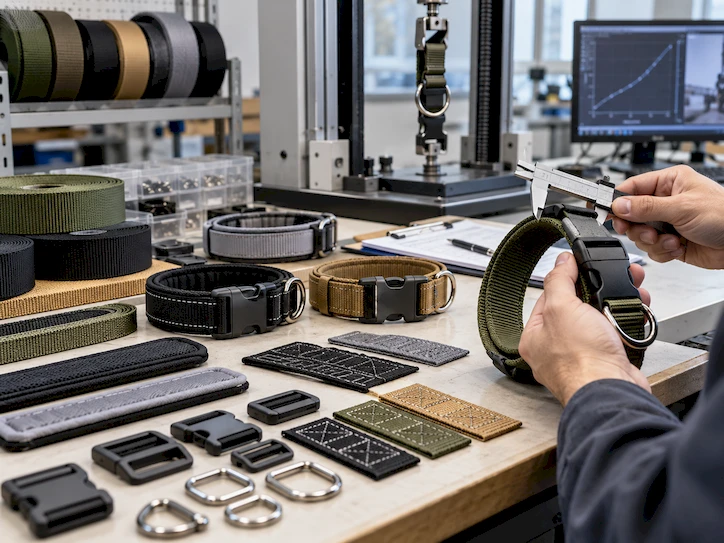
Dog Collar manufacturing begins before sewing. In fact, reliable production depends on controlled specifications, materials, dimensions, hardware, assembly, and inspection working together.
1. Product Specification and Development
A production specification may define finished circumference, minimum and maximum adjustment, webbing width, webbing thickness, buckle dimensions, ring dimensions, padding, thread, logo placement, and packaging.

2. Material Cutting and Preparation
Next, webbing and auxiliary materials are cut according to controlled dimensions. Even small differences can become important on compact collar sizes.
Therefore, dimensional tolerance can have a meaningful effect on the finished adjustment range of small Dog Collars.
3. Hardware Assembly
After cutting, buckles, sliders, D-rings, O-rings, and rectangular rings are installed according to the approved construction.
At this stage, hardware orientation matters. An appropriate component can still perform poorly if it is assembled incorrectly.
4. Sewing and Reinforcement
Structural connections may use parallel stitches, rectangular stitching, box-X stitching, or multiple reinforcement passes. The most suitable method depends on webbing thickness, hardware, thread, seam geometry, and expected load direction.

5. Branding
Once the structure is defined, private-label Dog Collars can be branded through screen printing, heat transfer, sublimation, woven labels, embroidery, rubber logos, silicone logos, laser engraving, or metal badges.
6. Finished Product Inspection
Finally, inspection should verify finished dimensions, adjustment range, buckle operation, hardware orientation, stitching, logo placement, color consistency, visible defects, and packaging.

Real-World Mistake: Testing Only the Buckle
Buyers sometimes ask only for buckle breaking strength. However, a finished collar is a complete system rather than a single component.
For example, potential failure points include the buckle, D-ring, adjuster, webbing, stitching, folded connections, and material damaged during sewing.
A buckle rated to 500 N does not automatically make the completed collar a 500 N product if another structural component fails at a lower load.
Real-World Mistake: Copying a Sample Without a Specification
A buyer may send a reference collar and ask the factory to “make exactly this.” Although the sample is useful, it does not define acceptable tolerances, exact webbing thickness, thread specification, logo position, metal finish, packaging requirements, or cosmetic inspection criteria.
Therefore, a more reliable process combines a reference sample with a dimensional specification, material specification, and approved pre-production sample.
OEM and ODM Dog Collar Manufacturing
For retailers, distributors, importers, and pet brands, OEM production makes it possible to create a differentiated range instead of reselling completely generic Pet Collars.
WLVOGUE can develop custom Dog Collars and related walking products around the buyer’s intended market, design language, sizing structure, materials, hardware, branding, and packaging.
Custom Collar Types
- Flat Dog Collar
- Martingale Collar
- Tactical Dog Collar
- Reflective Dog Collar
- Personalized Dog Collar
Custom Materials
- Nylon webbing
- Polyester webbing
- Polypropylene webbing
- Neoprene padding
- Reflective materials
Custom Branding
- Woven labels
- Printed logos
- Embroidery
- Rubber or silicone patches
- Engraved hardware
Custom Packaging
- Hang tags
- Backing cards
- Barcode labels
- Retail boxes
- Private-label packaging
Custom Size Development
Instead of copying generic S, M, and L labels, an OEM buyer can build a size system around actual adjustment ranges.
However, final ranges should be validated using the approved collar construction because buckle length, webbing thickness, folding, and padding can all affect usable circumference.
Coordinated Product Collections
A single design can also be extended from a collar into matching dog leashes and harness and leash sets.
What Should B2B Buyers Include in a Dog Collar RFQ?
Instead of asking only for a unit price, buyers should define measurable requirements. As a result, different suppliers are more likely to quote comparable products.
| Requirement | Example Specification |
|---|---|
| Product | Flat Dog Collar |
| Webbing | Polyester |
| Width | 25 mm |
| Adjustment range | 35–50 cm |
| Buckle | Side-release buckle |
| D-ring | Metal |
| Padding | 2 mm neoprene |
| Branding | Woven label |
| Colors | 4 colors |
| Packaging | Printed backing card |
| Testing | Buyer-defined requirement |
Frequently Asked Questions
What is a dog collar called?
The normal English term is dog collar. Although “Dog Neck Collar” is understandable, it is less common in everyday native-English usage.
What are Pet Collars?
Pet Collars is a broader commercial term. Therefore, it can include Dog Collars, cat collars, and collars for other companion animals.
What is a regular dog collar called?
A conventional adjustable collar is generally called a Flat Dog Collar, flat collar, buckle collar, or quick-release collar, depending on its construction.
What is the collar for narrow-headed dogs called?
A Martingale Collar is commonly considered for dogs whose head and neck proportions make slipping out of a conventional collar easier. However, correct fitting remains essential.
Is a Martingale Collar the same as a choke collar?
No. A properly constructed Martingale Collar has a limited tightening range. In other words, its control loop limits how far the collar can close.
How tight should a Dog Neck Collar be?
A widely used guideline is to allow approximately two fingers between the collar and the dog’s neck. Nevertheless, an actual neck measurement and the manufacturer’s size chart provide a more precise basis for sizing.
Does a padded collar always create less neck pressure?
Not necessarily. Published pressure testing shows that construction geometry and contact area can influence peak pressure. Therefore, adding padding alone does not guarantee lower pressure.
Can all Dog Collars use the same size chart?
No. Buckle length, webbing thickness, padding, folding method, adjuster design, and collar structure can all change the usable circumference.
Conclusion: What Is a Dog Collar Called?
The standard term is dog collar, while Dog Neck Collar is a descriptive alternative sometimes used in search and sourcing terminology. Meanwhile, Pet Collars describes the broader commercial product category.
More specific names identify particular constructions. For example, a Flat Dog Collar is the conventional adjustable everyday design, whereas a Martingale Collar contains a limited-slip section.
Published testing also shows why collar construction matters. One simulated-neck study reported pressures of approximately 83–832 kPa under different collar and force conditions. In addition, another study involving eight dogs recorded an average overall peak force of 30.2 N and demonstrated that padding alone does not necessarily reduce peak pressure.
For consumers, the practical lesson is to measure carefully and select equipment appropriate for the individual dog. For brands and wholesalers, however, the lesson is broader: define measurable dimensions, materials, hardware, adjustment ranges, sewing construction, branding, packaging, and testing requirements rather than relying only on product labels such as “premium” or “heavy-duty.”
Finally, WLVOGUE supports OEM and ODM development for custom Dog Collars and coordinated dog walking gear, including materials, colors, hardware, logos, sizing systems, packaging, leashes, and harness collections.