

Senior dog products are moving beyond a niche shelf of supplements and basic orthopedic beds.
For pet retailers, wholesalers, importers and private-label brands planning their 2027 assortments, the broader opportunity is increasingly centered on mobility, accessibility, comfort, home safety and easier daily care.
According to the American Pet Products Association, U.S. pet industry expenditure reached $158 billion in 2025. At the same time, approximately 71 million U.S. households owned dogs. APPA also projected total U.S. pet spending of $165 billion for 2026.
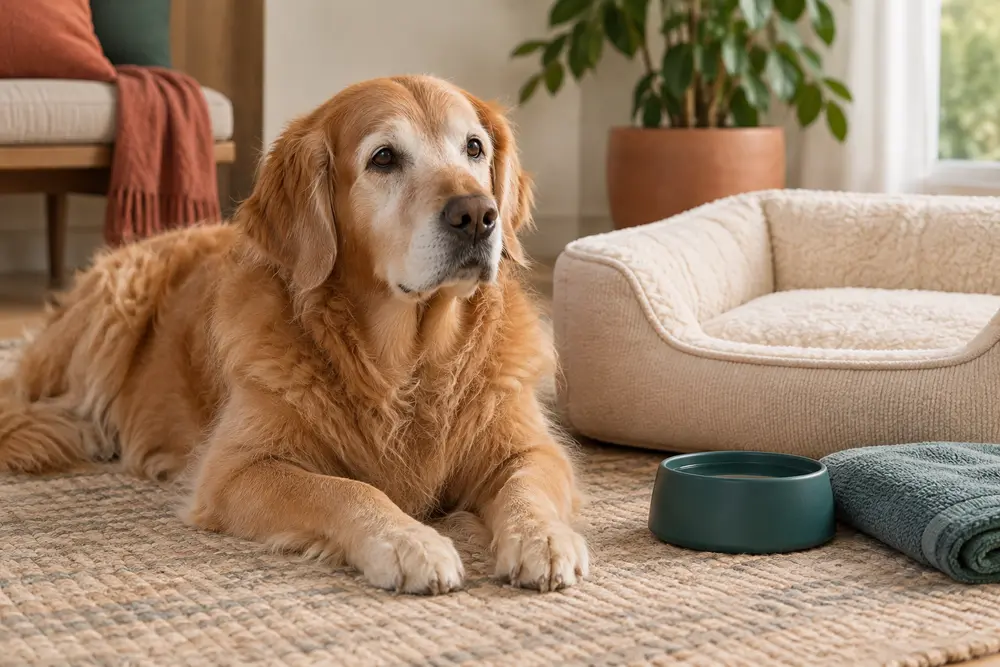
APPA’s July 22, 2026 Dog Report provides another useful signal. Rather than increasing spending evenly across every category, dog owners were becoming more selective about where they spent money.
View APPA 2026 Dog Report announcement
That distinction matters for senior dog products. In particular, products with an easily understood functional purpose may have a clearer value proposition than items relying mainly on age-related marketing claims. For example, helping a dog enter a vehicle, improving footing on hard flooring or assisting an owner with lifting addresses a visible everyday problem.
Veterinary guidance supports many of these categories as well. The American Animal Hospital Association discusses ramps, traction surfaces, padded harnesses, toe grips, boots, socks and suitable bedding as possible environmental modifications for aging animals.
View AAHA Senior Care Guidelines
1. Orthopedic Dog Beds Are Becoming a Mainstream Premium Category
Supportive bedding is one of the clearest senior-dog product opportunities because it addresses a daily activity: resting. In addition, bedding can be upgraded through materials, foam construction and washable components without requiring major changes in consumer behavior.
AAHA recommends adequate padding and appropriate bedding as part of creating environments suitable for older pets, particularly those experiencing musculoskeletal limitations.
Retail Example: Pets at Home
In October 2024, GlobalPETS reported that UK retailer Pets at Home carried more than 130 core bedding lines. Of those products, more than 40% used supportive foam filling.
More importantly for retail buyers, Pets at Home reported that like-for-like sales of its memory-foam beds were up 40%.
This figure represents one retailer rather than the entire pet bedding market. Nevertheless, it provides a useful commercial example of supportive bedding becoming an important part of a large retail assortment.
Clinical Study: 40 Large Dogs Using an Orthopedic Bed
A clinical investigation involving Big Barker orthopedic dog beds evaluated 40 dogs in an open-label, single-center proof-of-concept study conducted through the University of Pennsylvania Veterinary Clinical Investigations Center.
The participating dogs were more than three years old, weighed over 70 lb and had radiographically confirmed osteoarthritis. During the 38-day study period, the dogs wore three-axis activity monitors while owners also completed standardized assessments.
Researchers interpreted lower nighttime activity as a possible sign of greater nighttime restfulness. However, the study was not a randomized comparison between multiple bed designs. Therefore, the findings should not be interpreted as proof that every orthopedic or memory-foam dog bed will produce the same result.
View Penn Vet clinical study report
The word orthopedic alone is not a complete product specification. Instead, buyers should ask suppliers for foam type, thickness, density, compression resistance, recovery performance, waterproof construction and recommended load.
2. Dog Ramps Have a Stronger Biomechanical Case Than Many Buyers Realize
Vehicle access is another relevant segment for senior dogs. While a ramp may look like a simple convenience product, biomechanical testing gives the category a more measurable functional basis.
Research Test: Dogs Jumping From Simulated Vehicle Boots
A 2018 study published in Veterinary Record tested 15 healthy adult dogs jumping from platforms representing common vehicle boot heights.
During the experiment, researchers measured peak vertical ground reaction force on the forelimbs. As the jumping height increased, the measured force also increased.
| Platform Height | Average Peak Vertical Force | Observed Pattern |
|---|---|---|
| 0.55 m | 27.35 ± 4.14 N/kg | Lowest measured loading |
| 0.65 m | 30.84 ± 3.66 N/kg | Higher loading |
| 0.75 m | 34.12 ± 3.63 N/kg | Highest measured loading |
The increase between heights was statistically significant. Therefore, the study provides measurable evidence that greater jumping heights were associated with higher forelimb loading in the dogs tested.
However, the researchers also noted that further work would be required to determine how these measurements relate to injury risk. For that reason, the study supports the functional rationale for easier vehicle access but should not be used to claim that a particular ramp prevents injury.
Product Development Considerations for Dog Ramps
For product developers, a senior dog car ramp should be designed around more than appearance and overall length. Important variables include ramp angle, usable width, traction surface, side protection, load capacity, hinge durability, folded dimensions and total product weight.
In addition, packaging deserves early consideration. A highly durable ramp may still become commercially unattractive if its packed dimensions push it into oversized parcel categories.
As a result, importers and distributors should evaluate both product performance and freight efficiency during supplier selection.
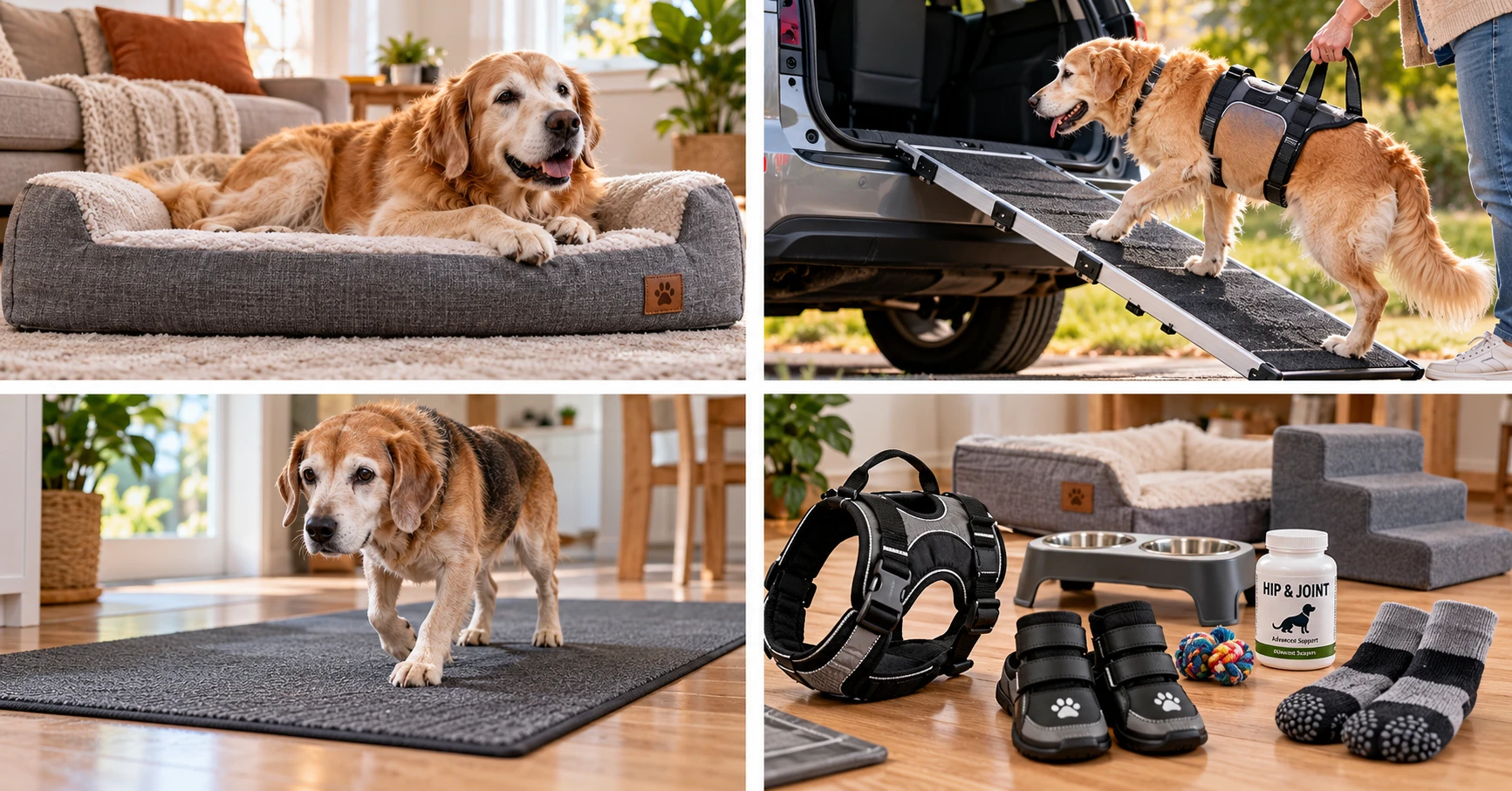
3. Mobility Harnesses and Lifting Slings Can Solve a Genuine Caregiver Problem
Senior mobility products are not only about the dog’s movement. They also affect how easily an owner can assist the animal.
For this reason, AAHA specifically discusses fitted, padded harnesses and lifting aids for larger senior pets. Consequently, there is room for a product category beyond conventional walking harnesses.
Potential products include rear-support slings, full-body mobility harnesses and dual-handle lifting systems. Each product serves a different assistance scenario, so they should not simply be treated as variations of a standard walking harness.
Design Differences Between Walking and Mobility Harnesses
Simply adding a handle to an existing walking harness does not automatically make the product suitable for lifting.
Once a harness carries part of an animal’s body weight, the engineering requirements change. For example, pressure distribution, seam strength, handle attachment points and lining materials become more important.
Caregiver ergonomics also matter. A handle that is too short may force a user to bend excessively while helping a larger dog. Therefore, handle height and body size should be considered together during prototype development.
Useful OEM Specifications
- Reinforced lifting-handle attachment points
- Wide padded load-bearing panels
- Breathable inner lining
- Multiple adjustment points
- Defined working-load specification
- Seam and buckle strength testing
4. Traction Products for Senior Dogs: What the Research Shows
Slippery flooring is frequently mentioned in senior-care guidance. AAHA, for example, recommends options including rugs, traction surfaces, toe grips, boots and socks.
These recommendations create opportunities for pet retailers and product developers. At the same time, different traction products should not automatically be assumed to produce the same result in every dog or situation.
Controlled Study: Nail Grips After TPLO Surgery
A 2022 study published in Animals evaluated nail grips in 30 dogs during the first two weeks following tibial plateau leveling osteotomy, commonly known as TPLO.
Thirteen dogs received nail grips, while seventeen received sham grips. Researchers then compared visual lameness, pressure distribution and several owner-reported mobility measures.
| Measured Outcome | Day 14 Result | Statistical Finding |
|---|---|---|
| Visual lameness score | p = 0.44 | No statistically significant difference |
| Total pressure index | p = 0.59 | No statistically significant difference |
| Walking on slippery flooring | p = 0.78 | No statistically significant difference |
| Ability to rise | p = 0.80 | No statistically significant difference |
In this study, researchers did not find statistically significant differences between the nail-grip and sham groups for the main outcomes measured during the two-week post-operative period.
However, this result should be interpreted within the study’s specific conditions. It does not establish that nail grips are ineffective in every dog, for every mobility problem or over a longer period. The authors also reported that the devices were generally well tolerated and recommended further research.
This study illustrates why product claims should match the available evidence. Traction products can still be sold around measurable characteristics such as grip, coverage, fit, washability and material construction without making unsupported claims about clinical recovery or mobility improvement.
5. Stair Safety Creates Opportunities for Gates, Ramps and Home-Access Products
A 2025 retrospective study reviewed 61 dogs presented to two university teaching hospitals after falling down stairs between January 2017 and July 2022.
The cases included both neurological and extremity injuries. Importantly, some injuries were classified as moderate or severe.
| Reported Injury Category | Percentage of Cases |
|---|---|
| Mild neurological spinal impairment | 18% |
| Moderate neurological impairment | 11% |
| Severe neurological impairment | 5% |
| Mild extremity injury | 28% |
| Moderate extremity injury | 7% |
| Fractures categorized as severe extremity injuries | 13% |
View stair-injury study on PubMed
The study does not prove that a particular gate, stair tread or ramp prevents injury. Nevertheless, it demonstrates that stair falls can result in clinically significant injuries.
For retailers, this creates a practical home-safety angle. Potential B2B opportunities include modular pet gates, non-slip stair treads, indoor ramps and low-profile transition ramps.
6. Accessible Feeding Products Need Careful Product Positioning
Adjustable feeding stations are often marketed to older dogs because bending down may become more difficult for some animals.
AAHA includes elevation of food and water bowls among possible home modifications for selected senior pets. However, research does not support treating raised feeding as a universally beneficial option for all dogs.
What Research Says About Elevated Feeding Bowls
A prospective Purdue University study involving 1,637 large and giant breed dogs examined risk factors for gastric dilatation-volvulus, commonly known as GDV.
In the studied population, use of a raised feeding bowl was associated with increased GDV risk. Researchers estimated that approximately 20% of GDV cases among large breeds and 52% among giant breeds in that study were attributable to raised feeding bowls.
Later evidence reviews added further context. In particular, a Veterinary Evidence review noted conflicting findings and concluded that there was no evidence showing that raised feeders reduce GDV risk.
View Veterinary Evidence review
Adjustable feeding stations can still be useful products for selected dogs. However, marketing should focus on features such as adjustability, stability, removable bowls, anti-slip construction and ease of cleaning rather than universal health claims.
7. Senior Enrichment Should Match an Older Dog’s Physical Abilities
Physical decline does not eliminate a dog’s need for mental stimulation. Instead, the type and intensity of enrichment may need to change.
Cornell University’s College of Veterinary Medicine notes that canine cognitive dysfunction may occur in older dogs. Its guidance discusses environmental enrichment, interactive toys, play and appropriate exercise as parts of supportive management.
View Cornell guidance on canine cognitive dysfunction
Cornell’s senior-dog enrichment guidance also recommends adapting activities to an older dog’s physical ability. For example, lower-impact scent-based or food-based activities may provide stimulation without requiring high levels of physical movement.
View Cornell senior dog enrichment guidance
Product Development Opportunities
Instead of making puzzle toys progressively harder, senior-focused enrichment products may need to reduce physical barriers while maintaining cognitive interest.
In practice, this could mean larger components, easier access to treats and lower resistance during play.
- Large handles or tabs
- Shallow treat compartments
- High-contrast components
- Soft scent-search toys
- Lower-resistance moving parts
- Adjustable puzzle difficulty
- Large-grip plush toys
An existing difficult puzzle toy should not automatically be repositioned as a senior product. Reduced vision, neck mobility, paw dexterity and jaw strength can all change how an older dog interacts with a toy.
8. Hygiene, Bedding Protection and Senior Care Kits Can Create Repeat-Purchase Opportunities
Everyday hygiene can become more important as dogs experience changes in mobility, elimination patterns or grooming tolerance.
As a result, practical products such as reusable dog diapers, belly bands, waterproof bed liners, washable absorbent pads, wipes and easy-grip grooming accessories may have long-term retail potential.
APPA’s 2026 Dog Report also provides broader evidence of increased interest in at-home care. The association reported that 51% of dog owners groomed their dogs themselves, while ownership of dog wipes had more than doubled year over year in its survey data.
Bundling creates another opportunity. AAHA specifically discusses senior care kits and environmental modifications involving ramps, bedding, traction surfaces, mobility harnesses and barriers.
View AAHA senior care kit guidance
Mobility Collection
Lifting harness, traction mat and portable ramp.
Comfort Collection
Supportive bed, waterproof liner and replacement cover.
Hygiene Collection
Reusable pads, washable diapers and grooming wipes.
Enrichment Collection
Easy puzzle toy, scent mat and soft interactive toy.
What the Real-World Evidence Tells Pet Product Buyers
Looking across these cases, a clear pattern emerges.
The opportunity in senior dog products is closely connected to observable functional needs. However, the level of research behind individual products and claims varies considerably.
For example, the Pets at Home case provides commercial evidence that supportive bedding can perform within a large retail assortment. Meanwhile, the Penn Vet investigation shows that one orthopedic bed design has undergone structured clinical evaluation.
Similarly, vehicle-jump testing demonstrates that higher jumps measurably increased forelimb loading in the dogs tested. By comparison, the nail-grip study found no statistically significant differences in its main outcomes during the specific two-week post-operative period.
The elevated-bowl evidence also demonstrates why individual product features should not automatically be translated into broad health claims.
Therefore, B2B buyers should evaluate what a study actually tested, which dogs were included, how long the study lasted and whether the findings apply directly to the product being sourced.
A Practical Testing Framework for OEM and ODM Buyers
For brands developing senior dog products, supplier evaluation should move beyond catalog images and sample appearance.
Instead, buyers should define measurable performance requirements before mass production begins.
| Test Area | What Buyers Should Check | Relevant Products |
|---|---|---|
| Load testing | Test above intended working load | Ramps, stairs, mobility harnesses |
| Traction testing | Compare dry and wet surface grip | Mats, ramps, stairs, socks |
| Compression testing | Measure foam compression and recovery | Orthopedic beds and mats |
| Wash testing | Check shrinkage, seams and backing separation | Covers, diapers, pads, mats |
| Fit testing | Test several breeds and body shapes | Harnesses, socks, wearables |
| Usability testing | Assess real interaction with older dogs | Ramps, beds, feeding products, toys |
| Claim review | Avoid unsupported treatment or prevention claims | All functional senior products |
| Carton optimization | Evaluate freight and parcel-size impact | Ramps, stairs, large beds |
For example, load testing is particularly relevant for ramps and lifting harnesses. Meanwhile, repeated wash testing is more important for covers, absorbent pads and washable hygiene products.
By matching the test method to the actual product risk, brands can create more meaningful specifications and compare suppliers more objectively.
Where the 2027 Opportunity Is Likely to Be
The senior-dog category should not be treated as one isolated segment. Instead, it intersects with bedding, travel, walking equipment, feeding, grooming, toys and home accessories.
For retailers, senior-friendly products can remain inside existing departments while also being grouped into dedicated online collections. This approach can improve product discovery without requiring stores to create an entirely separate department.
For wholesalers and distributors, meanwhile, the opportunity may be in building coordinated ranges rather than carrying dozens of unrelated products labeled “senior.”
Private-label brands may also differentiate through measurable functional design.
For instance, a ramp with defined load and traction specifications offers buyers more useful information than one described only as “senior friendly.” Likewise, an orthopedic bed with documented foam construction or a mobility harness with reinforced weight-bearing seams gives professional buyers more concrete criteria for comparison.
Pet brands and retailers developing these ranges can also work with an experienced pet products supplier and OEM/ODM manufacturing partner to customize materials, dimensions, colors, packaging, logos, product sets and retail-ready specifications for different markets.
What to Watch Next
Going into 2027, several signals are worth monitoring.
First, buyers should watch whether major pet retailers continue expanding senior-specific assortments. Second, more brands may begin publishing measurable performance data instead of relying only on broad wellness claims.
At the same time, clearer separation between comfort claims and medical claims will remain important. Growth in low-impact enrichment products, mobility accessories and coordinated senior-care collections will also be worth tracking.
Ultimately, the more this category develops, the less useful it will be to simply print “Senior Dog” on an existing product.
A more useful sourcing question is:
What specific problem does this product address, and what specification, test result or research supports the claim being made?
For OEM and ODM development, this creates opportunities for manufacturers capable of supplying measurable specifications, reliable quality control, functional prototypes, test documentation and private-label packaging without overstating product benefits.
As a result, senior dog products developed around clear functional needs may remain commercially relevant well beyond the 2027 buying season.
Sources
- American Pet Products Association. U.S. Pet Industry Reaches $158 Billion in 2025, Poised for Continued Growth in 2026. March 26, 2026. Source URL
- American Pet Products Association. America’s Dog Owners Are Becoming Smarter Spenders. July 22, 2026. Source URL
- American Animal Hospital Association. 2023 AAHA Senior Care Guidelines for Dogs and Cats — Pain Management. Source URL
- American Animal Hospital Association. Senior Care Kits. Source URL
- GlobalPETS. A Retail Perspective on Orthopedic Pet Beds. October 18, 2024. Source URL
- University of Pennsylvania Veterinary Clinical Investigations Center. Big Barker Clinical Study Report. Source URL
- Pardey D, Tabor G, Oxley JA, Wills AP. Peak Forelimb Ground Reaction Forces Experienced by Dogs Jumping From a Simulated Car Boot. Veterinary Record, 2018. Source URL
- Effect of Nail Grips on Weight Bearing and Limb Function in 30 Dogs 2 Weeks Post Tibial Plateau Leveling Osteotomy. Animals, 2022. Source URL
- Retrospective Evaluation of Stair-Related Injuries in Dogs Presenting to Emergency Centers: 61 Cases. Source URL
- Glickman LT et al. Non-Dietary Risk Factors for Gastric Dilatation-Volvulus in Large and Giant Breed Dogs. Source URL
- Veterinary Evidence. Are Dogs That Are Fed From a Raised Bowl at an Increased Risk of Gastric Dilation Volvulus Compared With Floor-Fed Dogs? Source URL
- Cornell University College of Veterinary Medicine. Cognitive Dysfunction Syndrome. Source URL
- Cornell University College of Veterinary Medicine. Senior Dog Enrichment. Source URL