

Choosing a Dog Bed looks simple until you compare soft pillow beds, bolsters, orthopedic mattresses, memory foam beds, washable mats, cave beds, and heavy-duty designs.
The Best Dog Beds are not necessarily the softest, thickest, or most expensive. A good bed should match the dog’s body size, sleeping position, mobility, chewing habits, indoor environment, and cleaning requirements.
If you are trying to understand how to choose a dog bed, focus first on measurable factors: usable sleeping dimensions, foam thickness and construction, cover material, washability, access height, anti-slip performance, and durability.
This guide combines practical product specifications with veterinary guidance, published real-world testing, and manufacturing considerations used when developing pet bedding products.
What Is a Dog Bed?
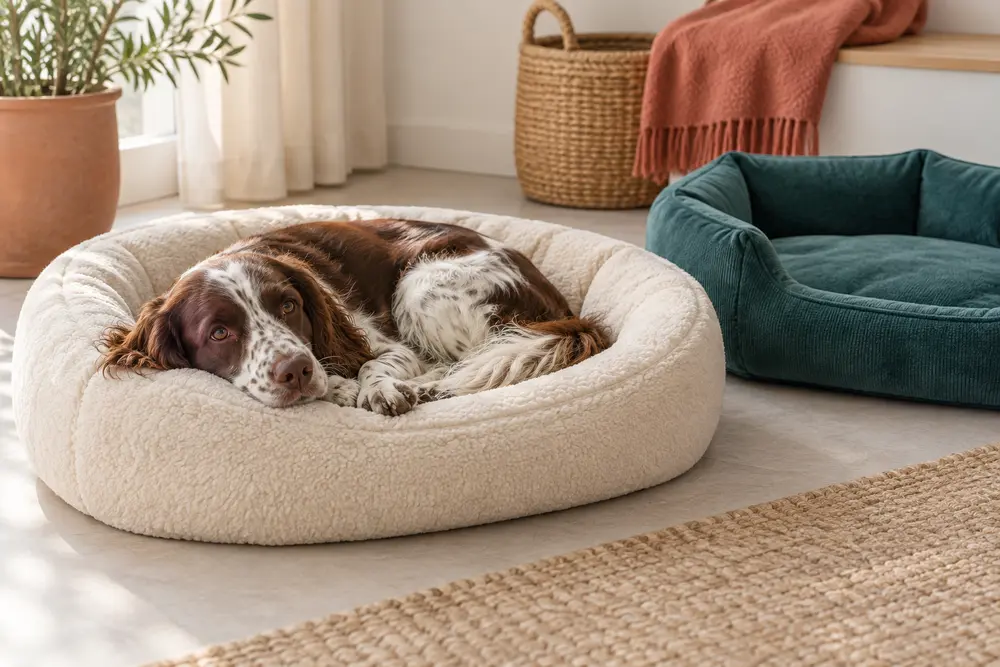
A dog bed is a dedicated resting surface designed to separate a dog’s body from the floor while providing cushioning, insulation, support, and a consistent place to sleep.
Depending on the design, a bed may contain a foam core, loose fiber filling, bolsters, waterproof liners, removable covers, anti-slip backing, or elevated supporting structures.
That construction matters because two beds that look almost identical in an online product photo can perform very differently after months of compression, washing, scratching, and daily use.
For example, a fluffy bed may feel exceptionally soft when first unpacked but lose loft rapidly. Meanwhile, a less visually plush Memory Foam Dog Bed may provide more stable support for a heavier dog.
Therefore, appearance should be treated as only one purchasing factor. Buyers can also compare different general dog beds according to construction, maintenance, and intended use.
How to Choose a Dog Bed by Size
The first step is measuring the dog rather than choosing according to a generic breed label.
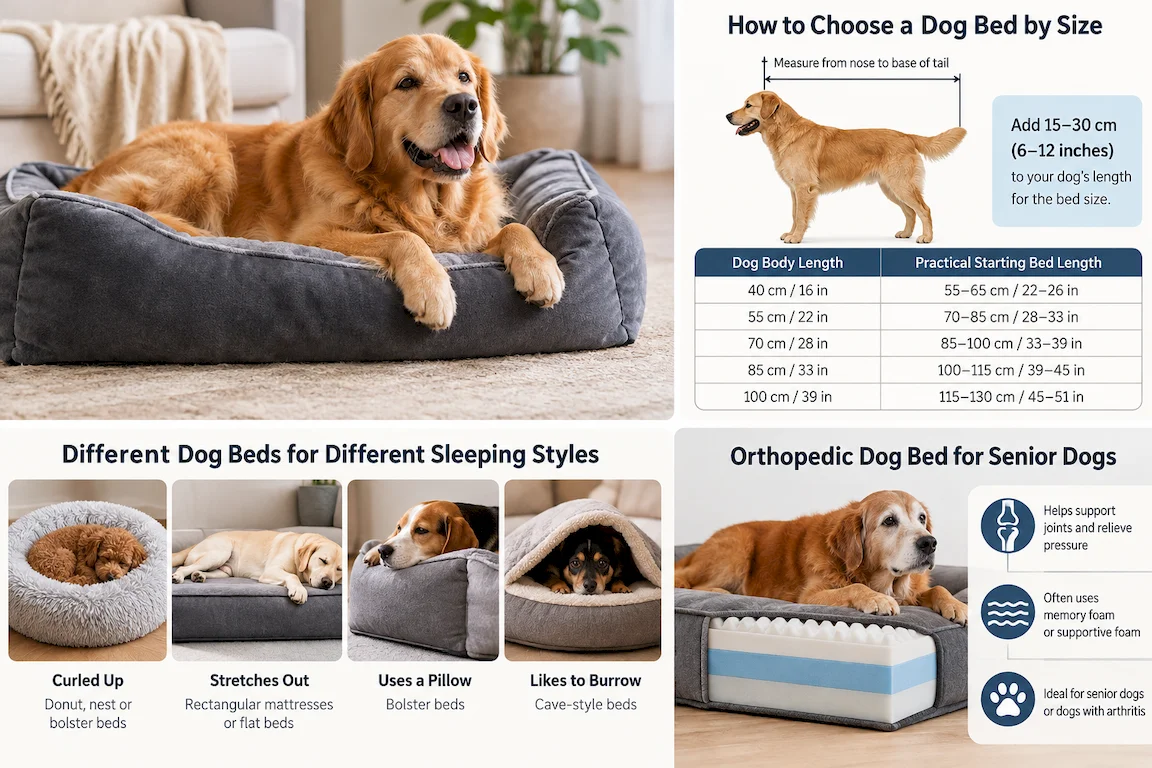
Measure approximately from the nose to the base of the tail while the dog is lying naturally. Then observe whether the dog normally curls up or stretches its legs fully.
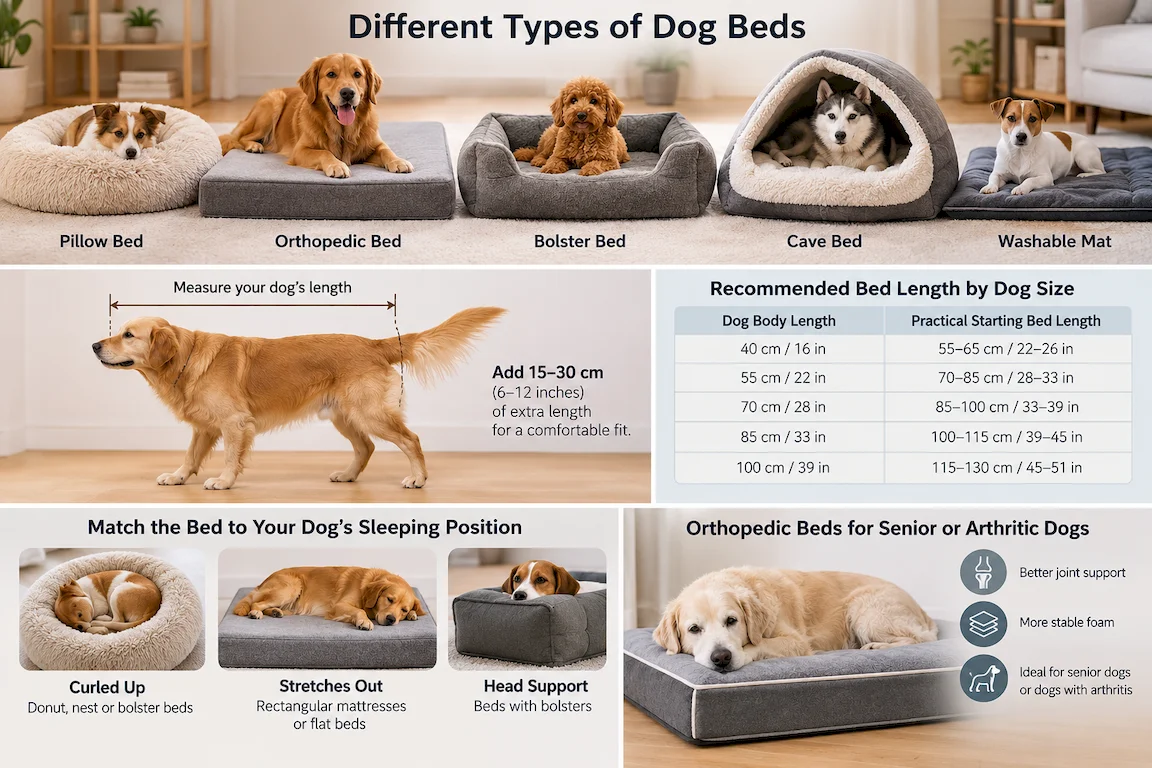
A practical starting point is to provide approximately 15–30 cm (6–12 inches) of additional usable length beyond the dog’s measured body length.
For giant breeds, veterinarian Dr. Robin Downing told PetMD that a bed may be approximately one-quarter longer than the dog when lying down, with enough width for unrestricted stretching.
| Dog Body Length | Practical Starting Bed Length |
|---|---|
| 40 cm / 16 in | 55–65 cm / 22–26 in |
| 55 cm / 22 in | 70–85 cm / 28–33 in |
| 70 cm / 28 in | 85–100 cm / 33–39 in |
| 85 cm / 33 in | 100–115 cm / 39–45 in |
| 100 cm / 39 in | 115–130 cm / 45–51 in |
These ranges are practical selection references rather than veterinary standards. Actual sleeping posture can significantly change the required sleeping area.
Why a Large Dog Bed Needs More Than an XL Label
One common mistake when buying a Large Dog Bed is trusting labels such as Large, XL, or XXL. These labels are not standardized between manufacturers.
In testing reported by The Spruce Pets, a KOPEKS orthopedic bed was used by two dogs weighing approximately 90–95 pounds each. The testing highlighted the importance of a large sleeping area and substantial support for heavier dogs.
| Specification | Example Bed A | Example Bed B |
|---|---|---|
| External dimensions | 100 × 75 cm | 110 × 85 cm |
| Usable sleeping area | 88 × 63 cm | 101 × 76 cm |
| Foam thickness | 5 cm | 10 cm |
| Bolster height | 15 cm | 18 cm |
| Removable cover | Yes | Yes |
The dimensions above illustrate why actual measurements are more useful than a size name alone.
Match the Dog Bed to the Dog’s Sleeping Position
Sleeping behavior can tell you more about comfort than many marketing claims.
Dogs That Curl Up
Donut beds, oval beds, bolsters, and enclosed designs can provide a defined sleeping area for dogs that naturally curl their bodies.
Dogs That Stretch Out
Rectangular mattresses and flat beds usually provide more uninterrupted surface area for dogs that sleep with their legs fully extended.
Dogs That Rest Their Head on an Edge
A bolster can provide a raised surface that functions similarly to a pillow while retaining a large central sleeping area.
Dogs That Like Covered Spaces
Cave-style beds, blankets, and partially enclosed beds may suit dogs that naturally seek sheltered sleeping areas.
AKC also recommends considering a dog’s size, coat, age, and preferred sleeping style when selecting bedding.
Dogs that enjoy enclosed or soft nesting environments may also respond well to selected calming dog beds or appropriately sized dog blankets.
There is no universal Most Comfortable Dog Bed. A deep fluffy nest may suit a small curling sleeper but be uncomfortable for a large dog that wants to stretch completely flat.
When Should You Consider an Orthopedic Dog Bed?
An Orthopedic Dog Bed is generally designed to provide more stable body support than a lightly filled cushion.
PetMD’s veterinary-reviewed guidance notes that senior dogs, particularly those experiencing arthritis or hip problems, may benefit from sturdy supportive foam. Orthopedic designs commonly use memory foam or other structured foam materials.
VCA Animal Hospitals also notes that extremely soft sleeping surfaces may not adequately support aging joints and that comfortable padding should be combined with a stable surface and easy access for dogs with mobility limitations.
Soft and supportive are not the same thing. A bed can feel soft when pressed by hand while still collapsing almost completely beneath a 40 kg dog.
Memory Foam Dog Bed: What Should You Actually Check?
Memory foam is commonly used in orthopedic beds because it conforms under pressure while offering a more structured sleeping surface than loose polyester filling.
However, simply describing a product as a Memory Foam Dog Bed is not enough. Buyers should also investigate:
- Foam thickness
- Foam density where disclosed
- Single-layer or multi-layer construction
- Compression under realistic load
- Recovery after prolonged pressure
- Protection from water and accidents
- Whether the foam can be removed before washing
PetMD reports that many orthopedic memory-foam beds contain approximately 4 inches of foam, while some designs reach approximately 7 inches.
Verified Construction Example
An orthopedic Cozy Cave bed listed through the AKC Shop uses a 3-inch orthopedic foam base plus a 2-inch polyester batting layer, with a machine-washable cover.
Common Mistake: Assuming Thicker Foam Is Always Better
A 10 cm bed using poor-quality foam may compress more under load than an 8 cm multi-layer structure engineered for greater support. Thickness should therefore be evaluated together with compression and recovery performance.
Washable Dog Bed or Removable Cover?
A Washable Dog Bed can mean two different things. Either the complete bed can be washed, or only the removable outer cover is machine washable.
These designs behave very differently in real use.
AKC recommends selecting bedding that is easy to clean and specifically highlights removable machine-washable covers as a useful feature, especially for puppies, senior dogs, and dogs that frequently bring dirt indoors.
Why Dog Beds With Removable Covers Are Practical
Dog Beds With Removable Covers allow the highest-wear component of the bed to be washed or replaced separately.
This is particularly useful for foam beds. If the foam still performs correctly but the cover becomes scratched, stained, or worn, a replacement cover may extend the practical service life of the complete bed.
The Spruce Pets reviewed replacement covers made from materials including waterproof textiles, denim, polyester, and cotton. One user experience cited in the review described an L.L.Bean denim cover reportedly remaining in use for approximately 20 years and through two dogs.
This is a consumer experience rather than a controlled laboratory lifespan test, so it should not be interpreted as a guaranteed durability figure.
Real-World Wash Test
In published testing by The Spruce Pets, more than 70 dog beds were evaluated across several testing rounds.
During one puppy-bed test, a MidWest QuietTime bed was used for months by a 15-pound pug. The dog frequently brought a peanut-butter-filled Kong onto the bed, which led to repeated machine washing and drying. The tester reported that the bed continued to retain its shape.
A Frequent Cleaning Mistake
A large fiber-filled bed can absorb substantial water, become very heavy during washing, and take a long time to dry. Large foam cores generally should not simply be placed into a washing machine.
For that reason, consider three separate questions:
- Is the outer cover machine washable?
- Is the internal cushion washable?
- Is the foam protected by a waterproof or water-resistant liner?
What Makes Durable Dog Beds Actually Durable?
Durable Dog Beds depend on multiple construction details working together.
Outer fabric matters, but seam design, zipper location, thread strength, corner construction, piping, and whether the dog can easily grab loose material are also important.
Common materials include polyester Oxford fabric, canvas, denim-style textiles, woven rip-stop materials, and coated synthetics.
Commercial products may also specify materials as 210D, 420D, 600D, or heavier constructions. However, denier should not be treated as a universal durability score. Thicker yarn alone cannot compensate for weak seams or an exposed zipper.
Verified Durability Test: 65-Pound Bulldog vs. Dog Bed
The Spruce Pets reported testing 68 dog beds through four rounds of real-world household testing, with beds paired with actual dogs.
During testing of a K9 Ballistics elevated bed, a 65-pound English Bulldog described as a habitual bed destroyer repeatedly chewed and pawed at the product. The testers reported very little visible scratching during the test period.
In another test, an entire glass of water was poured onto a K9 Ballistics rectangle pillow bed. According to the testers, water did not reach the internal mattress during that test.
These results do not prove that a textile bed is indestructible. Instead, they demonstrate how durability claims can be evaluated using a defined dog, defined behavior, and observable results.
The “Chew-Proof” Trap
No textile bed should automatically be assumed to survive every dog.
A determined dog can apply concentrated force around zippers, piping, seams, corners, and loose fabric. The Spruce Pets also notes that exposed zippers and accessible filling can create particular problems for puppies that chew bedding.
For this reason, “chew-resistant” is generally a more realistic engineering concept than assuming any soft textile product is universally indestructible.
Choose Dog Bed Fabric According to the Environment
The same fabric is rarely ideal for every sleeping environment.
| Application | Material Priority |
|---|---|
| Indoor comfort bed | Soft hand feel, appearance, washability |
| Senior dog bed | Comfortable surface and supportive internal structure |
| Puppy bed | Washability and reduced exposed chew points |
| Outdoor bed | Moisture resistance and abrasion resistance |
| Travel bed | Low weight, portability and quick drying |
| Large dog bed | Structural fabric and strong seams |
| Premium indoor bed | Texture, color consistency and detailed finishing |
| Kennel or crate mat | Easy cleaning and dimensional stability |
Compact dog mats may work well in crates and casual resting areas, while travel dog beds generally benefit from lightweight construction and easier packing.
For warm environments or applications where airflow and floor separation matter, buyers can also consider elevated dog beds.
Waterproof and Water-Resistant Are Not the Same
A water-resistant fabric may temporarily repel a spill while still allowing moisture to enter through seams, zipper openings, or prolonged exposure.
A more complete moisture-management system may combine an external textile cover with a waterproof internal liner surrounding the foam.
PetMD specifically recommends considering waterproof liners beneath washable covers for giant-breed dog beds because they can help protect the internal structure and simplify cleaning.
Product claims should therefore reflect the actual construction. “Water-resistant outer fabric,” “waterproof internal liner,” and “fully waterproof construction” describe different levels of protection.
How Thick Should a Large Dog Bed Be?
There is no universal foam thickness suitable for every large dog. Body weight, foam density, layer structure, sleeping posture, and floor hardness all affect performance.
Published products illustrate how dramatically constructions can differ. The Spruce Pets’ testing included KOPEKS orthopedic configurations using approximately 5.5 inches of foam in one model and around 7 inches in another large-dog configuration.
This is another reason buyers should compare the exact product dimensions and construction instead of assuming products within the same general category are identical.
Dog Bed Types Compared
| Dog Bed Type | Support | Warmth | Cleaning | Typical Use |
|---|---|---|---|---|
| Flat mat | Low–Medium | Low | Easy | Crates and travel |
| Pillow bed | Medium | Medium | Easy–Medium | Everyday sleeping |
| Bolster bed | Medium–High | Medium | Medium | Dogs that like head support |
| Donut bed | Medium | High | Medium | Curling sleepers |
| Memory foam bed | High | Low–Medium | Easy with removable cover | Large or older dogs |
| Orthopedic bed | High | Medium | Easy with removable cover | Dogs requiring stable support |
| Water-resistant bed | Medium | Low | Easy | Utility and outdoor applications |
| Cave bed | Medium | High | Medium | Dogs that like sheltered spaces |
| Elevated bed | Medium | Low | Easy | Warm environments and outdoor use |
What Is the Most Comfortable Dog Bed?
Searching for the Most Comfortable Dog Bed can lead to misleading conclusions because comfort depends on individual behavior.
A large Greyhound that sleeps fully stretched may dislike the same deep donut bed that a small dog uses constantly. Likewise, a senior dog with reduced mobility may find high bolsters difficult to enter even when the sleeping surface feels luxurious.
PetMD’s orthopedic-bed guidance notes that dogs that stretch may prefer beds without surrounding sides, while curling dogs and dogs that like head support may prefer bolsters.
High bolsters can also make entry more difficult for some dogs with mobility problems.
Evaluate Comfort Through Behavior
- Does the dog voluntarily return to the bed?
- Can the dog change sleeping position easily?
- Does the dog’s full body remain on the sleeping surface?
- Can an older dog enter and exit without struggling?
- Does the dog frequently abandon the bed for the floor?
Real-World Case: Comfortable but Slippery
The Spruce Pets tested a FurHaven orthopedic lounger and reported that the test dog liked its combination of supportive foam and soft surface.
However, the testers also identified a practical weakness: the tested bed did not have a non-skid bottom and could move on the floor.
This illustrates why comfort should not be evaluated independently from stability and usability.
Choosing a Dog Bed for Puppies, Senior Dogs, and Large Dogs
Puppies
Puppies make washability especially important. Chewing also means exposed zipper pulls, buttons, decorative piping, and accessible loose filling require additional attention.
The Spruce Pets’ puppy-bed testing covered more than 70 beds overall and emphasized practical, easily cleaned products during early puppy development.
Senior Dogs
VCA recommends giving older dogs a comfortable and easily accessible sleeping area, particularly because aging dogs are more likely to experience mobility limitations and osteoarthritis.
Useful design features may include low entry height, supportive foam, a stable anti-slip base, removable cover, and internal moisture protection.
Large Dogs
Heavy breeds require close attention to usable surface dimensions and resistance to excessive compression. A visually thick fiber bed can become surprisingly thin after a heavy dog lies on it.
For commercial development, samples can be compared under representative loads to assess bottoming-out, edge collapse, and recovery.
Dog bedding is not a treatment for arthritis or other medical conditions. Dogs showing pain, persistent stiffness, reluctance to rise, or significant mobility changes should be evaluated by a veterinarian.
Cheap Dog Bed vs. Higher-Specification Dog Bed
| Construction | Entry-Level Bed | Higher-Specification Bed |
|---|---|---|
| Fabric | Lightweight polyester | Higher-spec upholstery or Oxford fabric |
| Internal support | Fiber filling | Structured or layered foam |
| Foam protection | Often none | Waterproof liner available |
| Cover | Fixed | Removable |
| Zipper | Basic exposed zipper | Concealed or protected zipper |
| Base | Standard fabric | Anti-slip construction available |
| Seams | Standard | Reinforced where required |
| Branding | Basic label | Embroidery, patch, print or woven label |
| Packaging | Folded polybag | Vacuum or customized retail packaging |
| Quality control | Basic visual inspection | Defined material and dimensional checks |
A higher specification does not mean every dog needs every available feature. The appropriate structure should match the intended application and target price.
How Dog Beds Are Manufactured
A well-designed bed begins with a measurable product specification rather than simply choosing a fabric and sending it to a sewing line.
1. Product Development and Specification
OEM development may begin from a reference sample, drawing, technical package, existing product, or buyer concept.
The specification can define dimensions, intended dog weight range, fabric structure, foam type, foam thickness, filling weight, zipper position, bottom material, logo method, colors, labels, tolerances, and packaging.

2. Material Inspection and Cutting
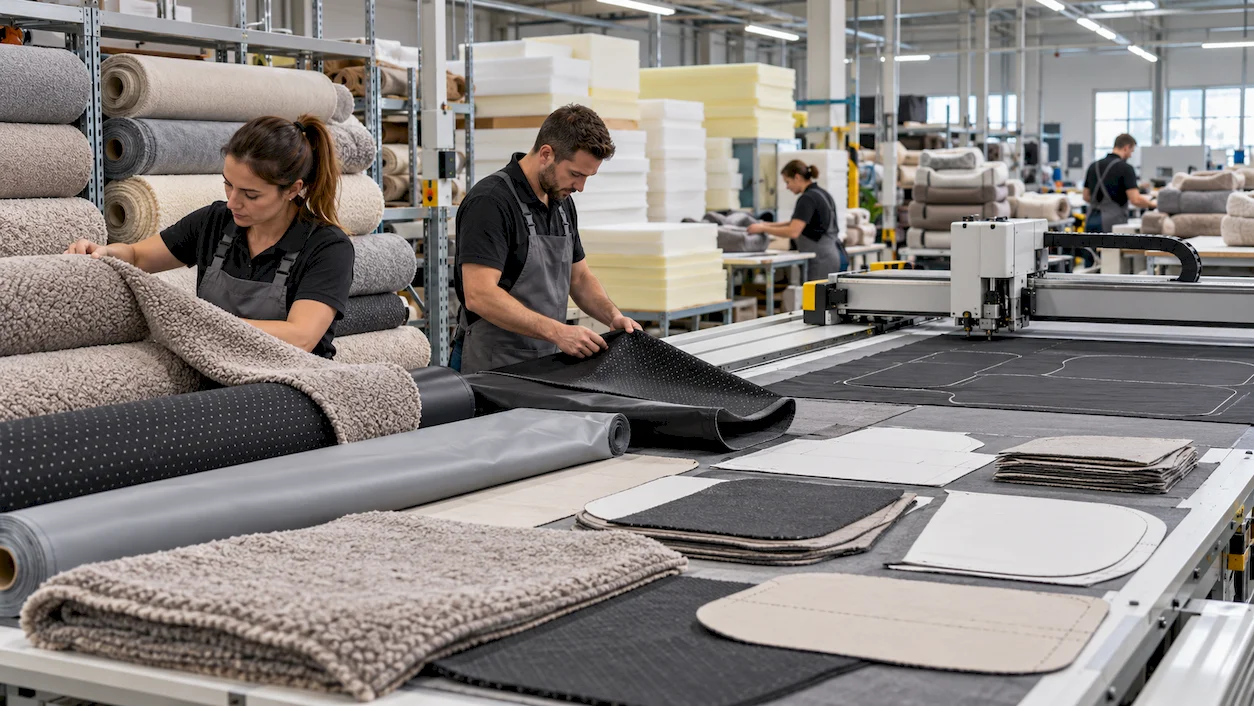
Fabric can be inspected before cutting for visible defects, shade variation, coating irregularities, contamination, or inconsistent material width.
Accurate cutting is especially important for bolster beds because multiple three-dimensional panels must align during sewing.
3. Sewing and Assembly
Depending on the bed specification, sewing may include reinforced seams, piping, concealed zippers, handles, waterproof liners, anti-slip bottom panels, labels, embroidery, printed branding, and separate bolster chambers.

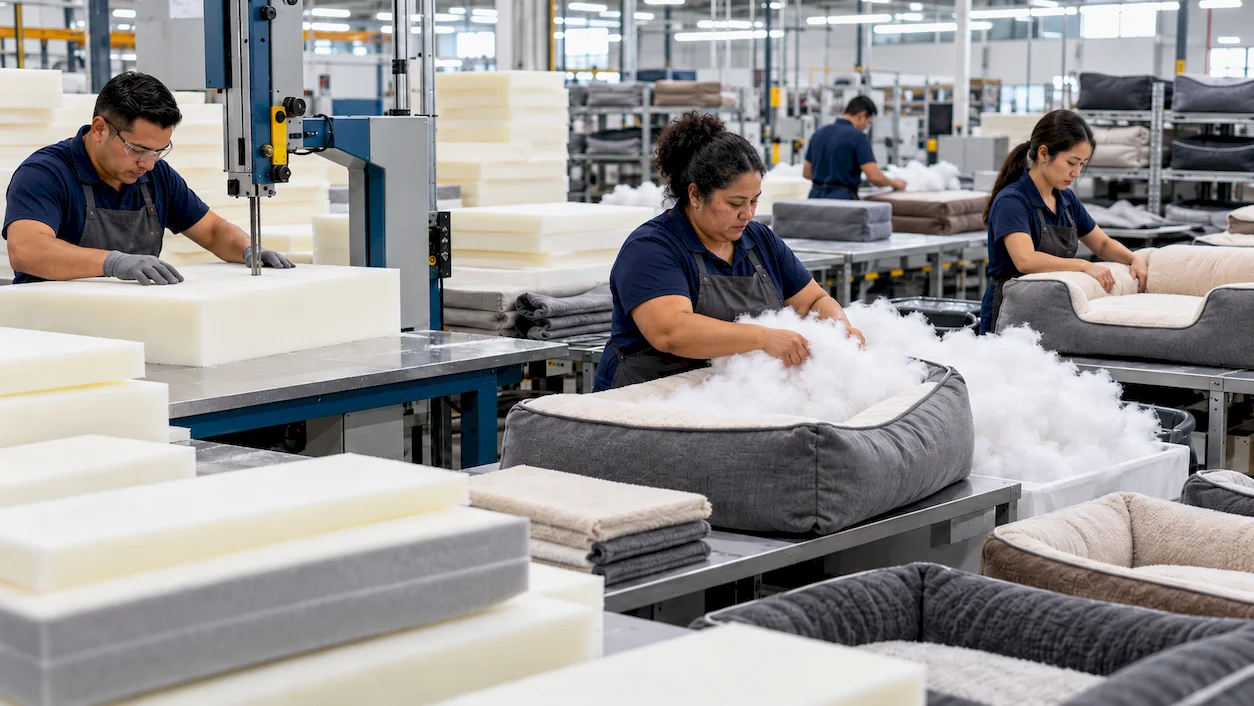
4. Foam Cutting and Filling Control
Foam cores are cut according to approved dimensions. Fiber-filled designs also require controlled fill quantity because inconsistent filling can change loft, appearance, and firmness across the same production batch.
For example, an OEM specification could define 1,250 ± 50 g of polyester filling instead of relying on an instruction such as “make the bed full.” This is an example of a measurable production specification rather than a WLVOGUE product performance claim.
5. Final Assembly and Quality Inspection
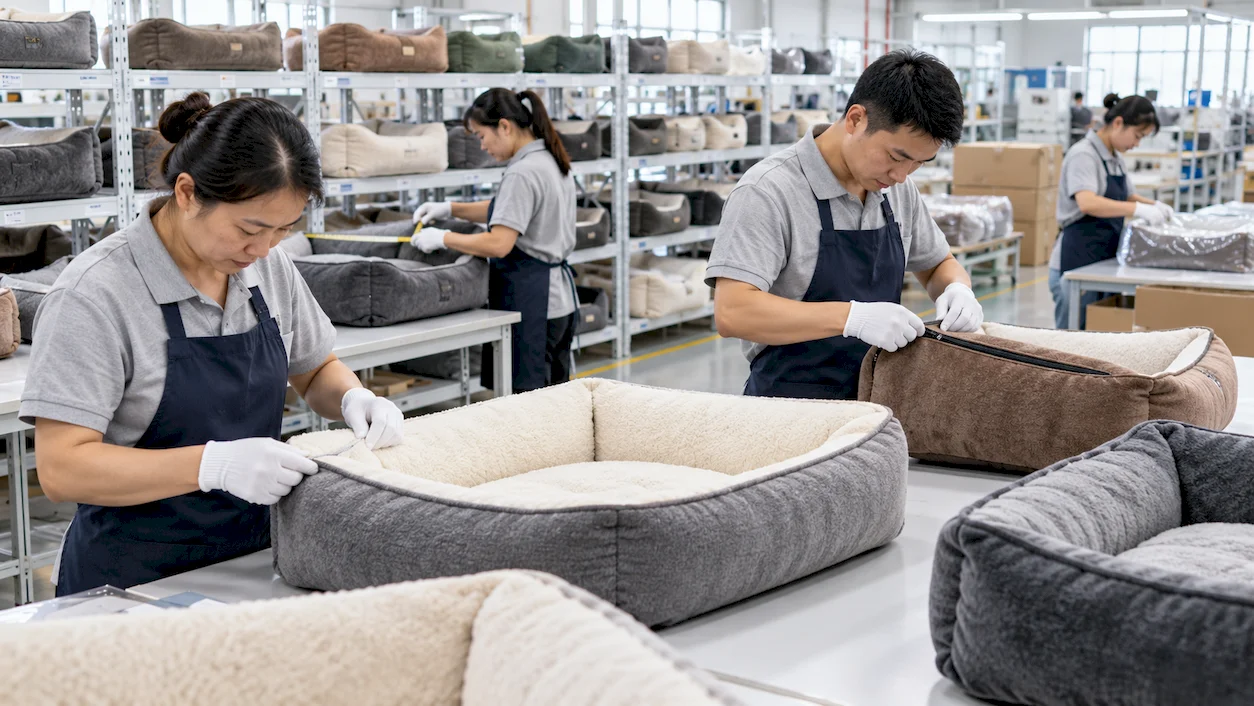
Finished inspection may cover dimensions, sewing consistency, loose threads, zipper operation, fabric appearance, filling distribution, logo placement, anti-slip construction, packaging accuracy, and overall cleanliness.
For wholesale manufacturing, quality control is not simply about identifying visibly defective units. Its broader purpose is maintaining repeatable construction across hundreds or thousands of products.
A Practical Dog Bed Sample Test Before Bulk Production
For OEM sourcing, one visually attractive sample is not enough. A more useful approach is recording measurable before-and-after data.
| Test | Initial Measurement | After Test | Evaluation |
|---|---|---|---|
| Foam height | 100 mm | 96 mm after recovery | Record recovery |
| Bed length | 900 mm | 895 mm | Check tolerance |
| Bed width | 700 mm | 697 mm | Check tolerance |
| Cover washing | Cycle 0 | Cycle 5 | Measure dimensional change |
| Zipper operation | New | Repeated operation | Pass or fail |
| Anti-slip test | Tile | Wood flooring | Compare movement |
| Vacuum recovery | Compressed | 24 hours unpacked | Record final dimensions |
The figures in this table illustrate a possible testing framework. They are not published performance claims for a specific WLVOGUE product. Actual test criteria and tolerances should be agreed before mass production.
How to Choose Dog Beds for Retail and Wholesale
Retail buyers need to consider factors beyond individual sleeping comfort.
Pet brands can explore WLVOGUE’s broader dog bed product category when developing a coordinated bedding range.
OEM and Private Label Dog Bed Manufacturing
WLVOGUE supports OEM and private-label pet product development for brands, retailers, wholesalers, distributors, and e-commerce sellers.
Dog bed customization can include:
A brand developing Durable Dog Beds for large active dogs might prioritize stronger outer fabric, concealed zippers, reinforced high-stress seams, thicker foam, replaceable covers, and internal waterproof protection.
A premium indoor collection might instead prioritize tactile fabric, coordinated colors, decorative finishing, layered foam, and branded packaging.
The same approach can be extended across general dog beds, orthopedic dog beds, elevated designs, and travel-oriented bedding.
Common Dog Bed Buying Mistakes
Choosing by breed name instead of measuring the individual dog.
Assuming XL means the same dimensions across different manufacturers.
Equating extreme softness with orthopedic support.
Comparing memory foam only by thickness.
Treating water-resistant and waterproof as identical claims.
Choosing a fully washable large bed without considering wet weight and drying time.
Ignoring exposed zippers when choosing a bed for a chewing puppy.
Buying an expensive permanent bed before learning a puppy’s sleeping habits.
Ignoring anti-slip performance on smooth flooring.
Assuming “chew-proof” means no dog can damage the bed.
Evaluating durability from photographs instead of construction specifications.
Buying a large foam bed without checking whether its cover can be removed.
Final Checklist: How to Choose a Dog Bed
Before purchasing or sourcing a dog bed, confirm the dog’s body dimensions, normal sleeping position, body weight, age, mobility, chewing behavior, preferred temperature, and sleeping environment.
- Measure the dog’s body instead of relying only on breed.
- Compare usable sleeping area rather than external dimensions alone.
- Check foam type, thickness, and compression behavior.
- Choose a bed shape that matches sleeping posture.
- Consider low-entry designs for dogs with limited mobility.
- Select removable covers when frequent cleaning is expected.
- Consider an internal waterproof liner for accident-prone dogs.
- Evaluate anti-slip performance on the intended floor surface.
- Check zipper position and exposed edges for chewing dogs.
- For wholesale orders, define dimensions, materials, tolerances, branding, and packaging before production.
The Best Dog Beds combine appropriate dimensions, suitable support, practical materials, convenient maintenance, and construction that fits the individual dog’s environment.
For pet businesses, these same principles can be converted into measurable OEM specifications so that comfort, materials, durability, branding, and packaging remain consistent from approved sample through bulk production.