

How much is a dog leash? For most everyday products, consumers can expect to pay roughly $8 to $40, although premium leather, technical outdoor, personalized, and designer models can cost considerably more.
The price of Dog Leashes depends on much more than length. Material thickness, hardware, stitching, handle construction, reflective components, personalization, packaging, brand positioning, and manufacturing volume can all affect the final selling price.
For dog owners, understanding these variables makes it easier to avoid paying for features they do not need. For pet brands and distributors, the same variables determine whether a product can be manufactured profitably for its intended retail market.
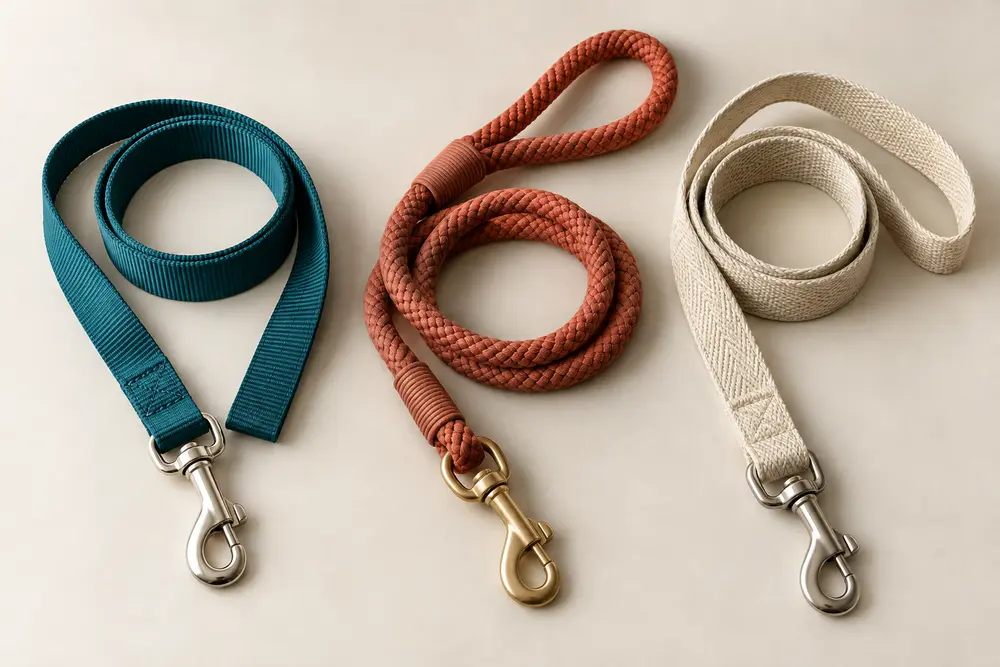
How Much Does a Dog Leash Cost?
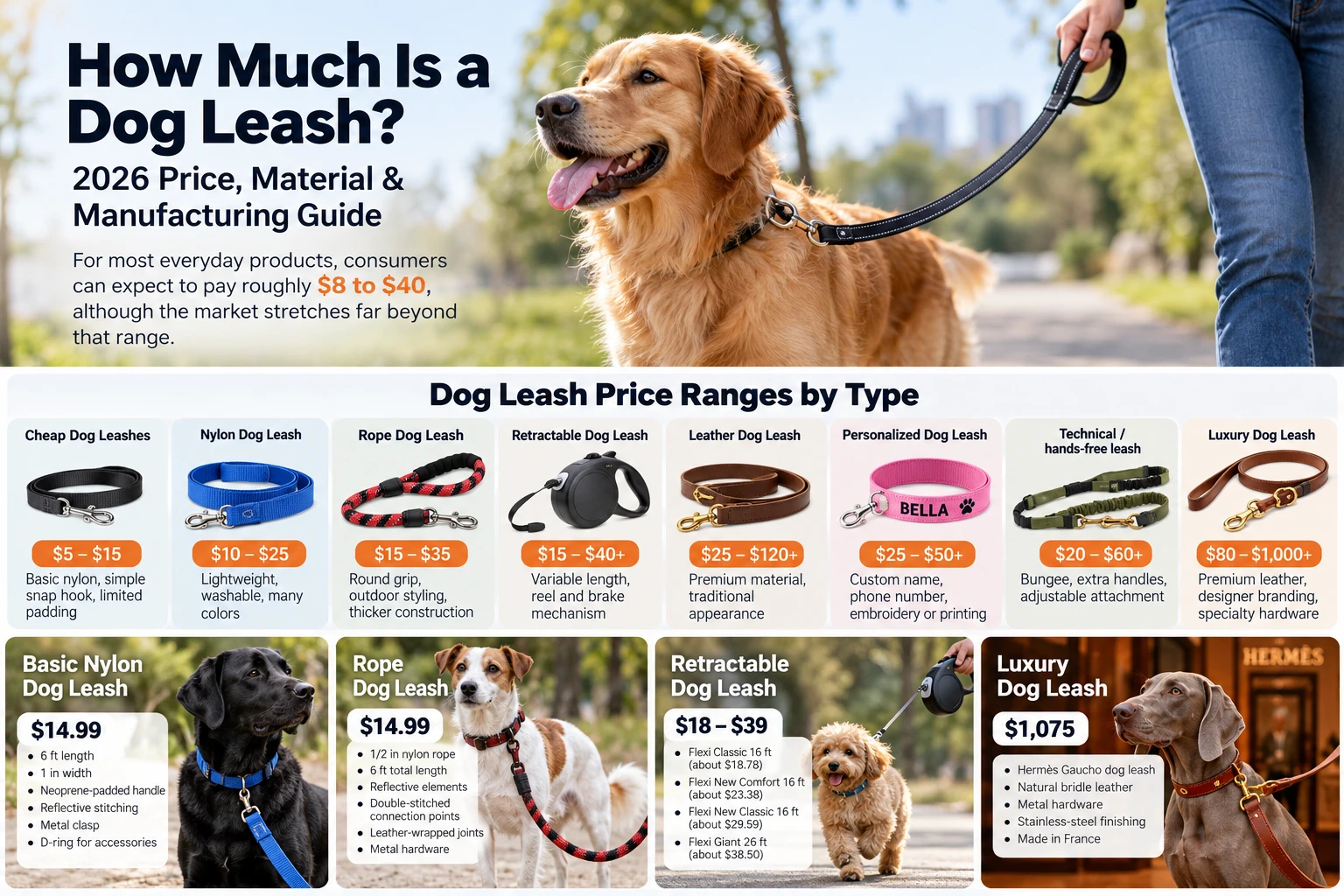
A useful starting point is to compare leash categories rather than looking for one universal price. The ranges below reflect common market positioning and should not be treated as fixed retail prices.
Basic nylon construction, standard hooks, and limited additional features.
Lightweight, washable, colorful, and suitable for extensive OEM customization.
Thicker round construction with an outdoor-oriented appearance and grip.
Includes a reel, internal spring, brake, casing, and variable-length lead.
Leather grade, edge finishing, stitching, hardware, and craftsmanship influence cost.
Names, phone numbers, logos, embroidery, printing, or custom labels add production steps.
Premium leather, designer branding, craftsmanship, specialty hardware, and exclusivity.
Hands-free systems, bungee sections, traffic handles, reflective details, or locking hardware.
| Dog Leash Type | Typical Retail Range | Common Characteristics | Main Price Drivers |
|---|---|---|---|
| Cheap Dog Leashes | $5–$15 | Simple everyday construction | Webbing, basic hook, packaging |
| Nylon Dog Leash | $10–$25 | Lightweight and customizable | Width, thickness, padding, reflective yarn |
| Rope Dog Leash | $15–$35 | Round grip and outdoor styling | Rope diameter, joints, hardware |
| Retractable Dog Leash | $15–$40+ | Variable walking distance | Reel, spring, brake, casing, tape or cord |
| Leather Dog Leash | $25–$120+ | Traditional premium construction | Leather grade, finishing, stitching, hardware |
| Personalized Dog Leash | $25–$50+ | Custom name or branding | Artwork, printing, embroidery, individual fulfillment |
| Luxury Dog Leash | $80–$1,000+ | Premium materials and designer positioning | Craftsmanship, branding, materials, exclusivity |
Real Dog Leash Price Examples
Looking at publicly listed products makes the difference between leash categories much easier to understand. Prices may change over time, but these examples illustrate how construction and market positioning influence retail price.
Basic Nylon Dog Leash: About $14.99
Max and Neo lists a 6 ft × 1 in nylon reflective leash at about $14.99. Its published specification includes 2 mm nylon webbing, a neoprene-padded handle, reflective stitching, a metal clasp, and an accessory D-ring.
View sourceRope Dog Leash: About $14.99
A 6 ft reflective rope model from the same brand is also listed around $14.99. Published specifications include 1/2-inch nylon rope, double-stitched connection points, reflective construction, and metal hardware.
View sourceRetractable Dog Leash: About $18–$39
Current Flexi examples on Chewy span roughly $18.78 to $38.50 across 16-ft and 26-ft cord or tape configurations. Mechanical complexity is one reason retractable products often cost more than simple flat leashes.
View sourceLuxury Dog Leash: $1,075 Example
Hermès lists its Gaucho dog leash at $1,075 on its U.S. website. At this end of the market, customers are paying for materials, craftsmanship, brand heritage, design, manufacturing origin, and exclusivity rather than simply greater tensile strength.
View sourceWhat Is a Dog Leash?
A dog leash connects a dog to its handler, normally through a hook attached to a dog collar or harness. Although the basic concept is simple, modern leash designs can serve very different purposes.
Common formats include flat nylon leashes, polyester leashes, rope leashes, leather leashes, retractable leashes, bungee leads, hands-free systems, traffic leads, long training lines, and adjustable multifunction designs.
Buyers building a complete walking collection can also coordinate a leash with dog harness and leash sets or other dog walking gear.
Cheap Dog Leashes: When Does a Low Price Become a Problem?
There is nothing inherently wrong with Cheap Dog Leashes. A manufacturer can create an affordable product by simplifying packaging, minimizing decorative components, standardizing materials, and producing larger quantities.
Problems appear when cost reduction reaches critical components. Warning signs can include extremely thin webbing, inconsistent stitching, poorly finished edges, undersized hardware, loose rivets, weak hook springs, sharp metal edges, or no clear size recommendation.
About $16.99 Retail vs Approximately $4 per Unit
Max and Neo lists an individual 6-ft double-handle reflective leash at approximately $16.99. The company also lists a 100-piece bulk package of 6-ft × 1-in reflective nylon double-handle leashes for $399.99.
This illustrates why a low bulk unit price does not automatically mean inferior raw materials. Purchase volume, simplified individual packaging, distribution model, and reduced retail handling can create a large difference between bulk and consumer pricing.
What Specifications Affect Dog Leash Cost?
1. Length
Common fixed-leash and training-line specifications include:
- 4 ft / 1.2 m: close everyday control.
- 5 ft / 1.5 m: balanced walking length.
- 6 ft / 1.8 m: common everyday format.
- 10–15 ft / 3–4.5 m: controlled training applications.
- 30–50 ft / 9–15 m: recall and long-line training.
Retractable products often use longer leads. Several mainstream models, for example, provide approximately 16 ft of extension, while larger models can reach around 26 ft.
2. Width and Thickness
Width and thickness should be specified separately. A leash measuring 1 inch wide can still vary significantly in total material thickness, density, flexibility, and finished weight.
Lighter materials and smaller hardware may provide a better user experience for small dogs. Therefore, making every leash as thick and heavy as possible is not necessarily an improvement.
Nylon Dog Leash: Why Is Nylon So Common?
A Nylon Dog Leash remains one of the most flexible product categories for both retail and OEM manufacturing. Nylon combines low weight, strong color flexibility, straightforward sewing, relatively easy cleaning, and competitive manufacturing cost.
Entry Level
Nylon webbing, standard hook, folded handle, simple packaging.
Mid Range
Reflective stitching, neoprene handle, accessory ring, improved hardware.
Premium
Custom webbing, branded fittings, traffic handle, rubber logo, custom retail packaging.
This scalability makes nylon especially suitable for brands developing coordinated dog leash collections.
Published Pull-Test Data: What Does “Strong” Actually Mean?
Marketing terms such as “heavy duty” and “super strong” are difficult to compare without measurable test criteria. Coastal Pet Products has publicly described a quality-control approach based on a minimum tensile standard of seven times the recommended pet weight.
The company also describes quality procedures that can include tensile testing, salt-spray testing, UV testing, static wet color-transfer testing, and crock testing.
These figures are manufacturer-reported QA standards rather than a universal industry requirement. Nevertheless, they demonstrate why measurable test criteria are more useful than vague strength claims.
View Coastal Pet quality assurance sourceRope Dog Leash: Bigger and Heavier Is Not Always Better
A Rope Dog Leash often looks more substantial than a narrow flat leash. However, diameter alone does not determine comfort.
Real Customer Feedback
On a publicly accessible 6-ft reflective rope leash product page, one customer reported that the clasp and leather closure felt heavy and could make contact with the dog’s chest or shoulder during walking. Another customer liked the leash overall but reported hand chafing during longer walks with a large dog.
These are individual consumer experiences rather than controlled laboratory findings. However, they highlight genuine design trade-offs involving rope texture, hook weight, joint size, and handle comfort.
View product page and customer reviewsFor an OEM rope leash project, useful evaluation points include:
- Rope diameter and flexibility
- Surface roughness
- Handle circumference
- Hook weight
- Hook length
- Joint dimensions
- Balance when hanging
- Whether hardware contacts the dog’s body while walking
Retractable Dog Leash: More Convenience, More Mechanical Complexity
A fixed leash may contain little more than webbing, stitching, and hardware. A Retractable Dog Leash, by comparison, contains an integrated mechanism.
As a result, quality inspection may need to evaluate extension and retraction consistency, brake response, lock engagement, tape tracking, spring return, housing fit, handle integrity, lead attachment, and hook operation.
Real Injury Data: Why Leash Control Matters
Dog leash design is not only about appearance. A 2023 study using U.S. emergency-department data estimated 422,659 leash-dependent dog-walking injuries among adults between 2001 and 2020.
The study does not establish that a particular leash material caused these injuries. Instead, the findings underline the importance of dog behavior, handler technique, product fit, leash control, and selecting appropriate walking equipment.
View PubMed studyAdditional Study in Adults Aged 65+
A separate JAMA Surgery analysis estimated 32,624 fall-related fractures associated with walking leashed dogs among U.S. adults aged 65 and older between 2004 and 2017. The study reported that 52.1% involved the upper extremities, 17.3% were hip fractures, 13.7% were wrist fractures, and 28.7% resulted in hospital admission.
View JAMA Surgery studyLeather Dog Leash: Why Can Prices Vary So Much?
A Leather Dog Leash can range from an accessible premium accessory to a luxury product costing hundreds of dollars.
Important variables include:
- Leather grade and hide selection
- Full-grain versus corrected leather
- Thickness and flexibility
- Tanning process
- Edge painting or burnishing
- Stitching density
- Brass or stainless-steel hardware
- Hand finishing
- Country of manufacture
William Walker, for example, publishes leather leash configurations with a standard width of 2 cm and a smaller 1.5 cm option. Its fixed city version is also described as approximately 90 g lighter than the adjustable version, demonstrating how hardware and configuration influence total leash weight.
View product specificationsPersonalized Dog Leash: What Does Customization Add?
A Personalized Dog Leash creates value through differentiation rather than simply using more raw material.
Personalization also adds workflow. A standard leash may move directly from cutting to sewing, inspection, and packing. Personalized production may require customer data preparation, artwork verification, customization, spelling checks, individual identification, and order-specific packing.
Common Personalization Pitfalls
- Incorrect spelling
- Wrong telephone number
- Incorrect font or color
- Wrong print orientation
- Logo-position inconsistency
- Personalization placed too close to stitching
- Customized unit packed for the wrong customer
Nylon vs Rope vs Leather vs Retractable Dog Leashes
| Feature | Nylon | Rope | Leather | Retractable |
|---|---|---|---|---|
| Typical price position | Low–Medium | Medium | Medium–High | Medium |
| Weight | Low | Medium | Medium | Medium |
| Color options | Excellent | Good | Moderate | Good |
| Pattern customization | Excellent | Moderate | Limited | Mainly casing or tape |
| Personalization | Excellent | Good | Excellent | Moderate |
| Cleaning convenience | High | Medium | Lower | Medium |
| Mechanical complexity | Low | Low | Low | High |
| OEM flexibility | Very High | High | High | Medium–High |
How Is a Dog Leash Manufactured?
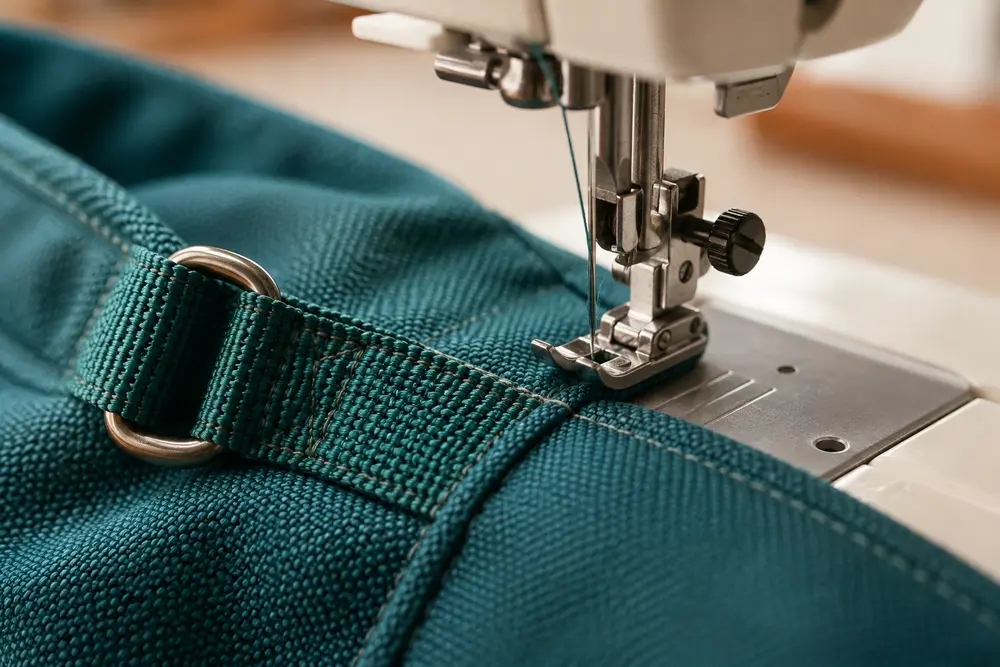
Manufacturing processes vary by leash material and structure. A conventional webbing leash typically follows a sequence of material preparation, cutting, component assembly, sewing, branding, inspection, and packaging.
Material Selection
Material, width, thickness, density, surface feel, color, and required finished length are defined. Rope products additionally require a specified diameter and flexibility.
Cutting
Webbing or rope is cut to controlled dimensions. Synthetic webbing can be heat cut to help seal the edge and reduce fraying.
Hardware Installation
Hooks, rings, buckles, sliders, and carabiners are positioned before permanent stitching.
Sewing and Reinforcement
Stress points may use parallel stitching, bartacks, rectangular reinforcement, or box-X patterns.
Branding
Logos can be applied through printing, woven labels, rubber patches, silicone patches, embossing, metal plates, or custom jacquard webbing.
Inspection and Packaging
Finished dimensions, stitching, hook operation, appearance, branding position, color consistency, and packaging accuracy can be checked before shipment.
Why the Finished Leash Should Be Tested as an Assembly
One common sourcing mistake is evaluating only raw webbing strength. A complete leash includes webbing or rope, thread, folded joints, hooks, swivels, handles, rings, and sometimes buckles.
If the hook, stitching, or joint fails before the webbing reaches its rated load, the strength of the raw material alone does not represent the performance of the finished product.

Choosing the Right Dog Leash by Use Case
Everyday Walking
A 4–6 ft flat leash works well for many routine walking environments. Reflective stitching, padding, and an accessory ring can add practical value without excessive complexity.
Small Dogs
Lower weight matters. Narrower webbing and appropriately sized hardware may be more comfortable than scaled-down dimensions paired with oversized metal components.
Large or Strong Dogs
Wider webbing, reinforced joints, comfortable handles, and suitable attachment hardware can be considered alongside appropriate training and handling.
Running
Hands-free models may combine waist attachment, adjustable sections, secondary handles, and elastic shock-absorbing components.
Hiking
Outdoor designs commonly use reflective materials, water-resistant components, rope or technical webbing, and locking hardware.
Training
Long lines can provide controlled distance during recall exercises. Other training situations may use specialized dog training collars alongside appropriate professional guidance.
Custom Dog Leash OEM and Private-Label Manufacturing
For pet brands, the most useful sourcing question is often not “What is the cheapest leash?” but rather “What specification fits our target customer, target retail price, and brand positioning?”

WLVOGUE can develop products for brands seeking custom Dog Leashes or complete walking-accessory collections.
Brands can also develop coordinated products through the wider WLVOGUE dog walking gear range.
What Should You Send a Dog Leash Manufacturer?
Reference photographs can help communicate a concept, but measurable specifications make quotations easier to compare and reduce misunderstandings during sampling.
How Much Should You Spend on a Dog Leash?
For everyday household use, many practical products fall within approximately $10–$30. Spending more can make sense when the additional cost provides a feature that matches the owner’s actual needs.
Meanwhile, inexpensive leashes can be perfectly practical when their materials, stitching, hardware, and construction match the intended dog and application. Price alone should not be treated as a measurement of safety or strength.
Frequently Asked Questions About Dog Leash Prices
How much is a basic dog leash?
Basic nylon models commonly fall around $8–$15, although promotions, size, construction, and brand can move the price outside this range.
How much is a Nylon Dog Leash?
Many mainstream nylon products fall around $10–$25 depending on width, thickness, reflective details, padding, hardware, and branding.
How much is a Rope Dog Leash?
A mainstream Rope Dog Leash commonly falls around $15–$35, while premium handmade versions can cost more.
How much is a Retractable Dog Leash?
Many mainstream models fall around $15–$40 or more. Length, tape versus cord construction, mechanism quality, and size can all affect the price.
How much is a Leather Dog Leash?
Mainstream leather products can begin around $25–$50, while premium handcrafted products frequently exceed $80–$100.
How much is a Personalized Dog Leash?
Many personalized products fall around $25–$50, although leather, custom hardware, embroidery, and individual fulfillment can increase the price.
How much is a Luxury Dog Leash?
Premium products can exceed $100, while designer examples can cost several hundred dollars or more. One current Hermès example is listed above $1,000.
Are expensive Dog Leashes always stronger?
No. Price may reflect craftsmanship, branding, leather grade, packaging, design, personalization, or exclusivity. Actual performance depends on the complete finished construction.
So, How Much Is a Dog Leash?
The wide price range demonstrates why cost alone tells very little about whether a leash is appropriate for a particular dog. Materials, dimensions, hardware, comfort, manufacturing consistency, testing, and intended use matter more than simply choosing the cheapest or most expensive option.
For pet brands, defining those details before requesting an OEM quotation makes supplier comparisons much more meaningful. A well-developed leash should achieve the right balance between usability, durability, manufacturing consistency, target price, and brand positioning.
Develop Your Next Dog Walking Product with WLVOGUE
Explore custom leash, collar, harness, material, hardware, branding, and private-label options for your pet product collection.