

Yes, Indestructible Dog Beds exist as a product category, but no fabric-based dog bed should be considered literally impossible to destroy. For dogs that repeatedly rip covers, expose foam, pull apart seams, or chew through ordinary bedding, a properly engineered Chew Proof Dog Bed, Chew Resistant Dog Bed, or Heavy Duty Dog Bed can provide a much more durable solution.
The strongest designs do not depend on thick fabric alone. Instead, they combine abrasion-resistant textiles, protected edges, fewer exposed seams, strong structural components, and sleeping surfaces that are difficult for a dog to grip with its teeth. You can explore different Dog Bed constructions from WLVOGUE to see how different designs address comfort, durability, cleaning, and everyday use.
There is no universally indestructible dog bed. However, well-designed heavy-duty beds can make chewing and tearing substantially more difficult by eliminating common failure points such as loose corners, exposed seams, accessible zippers, and easily gripped fabric.
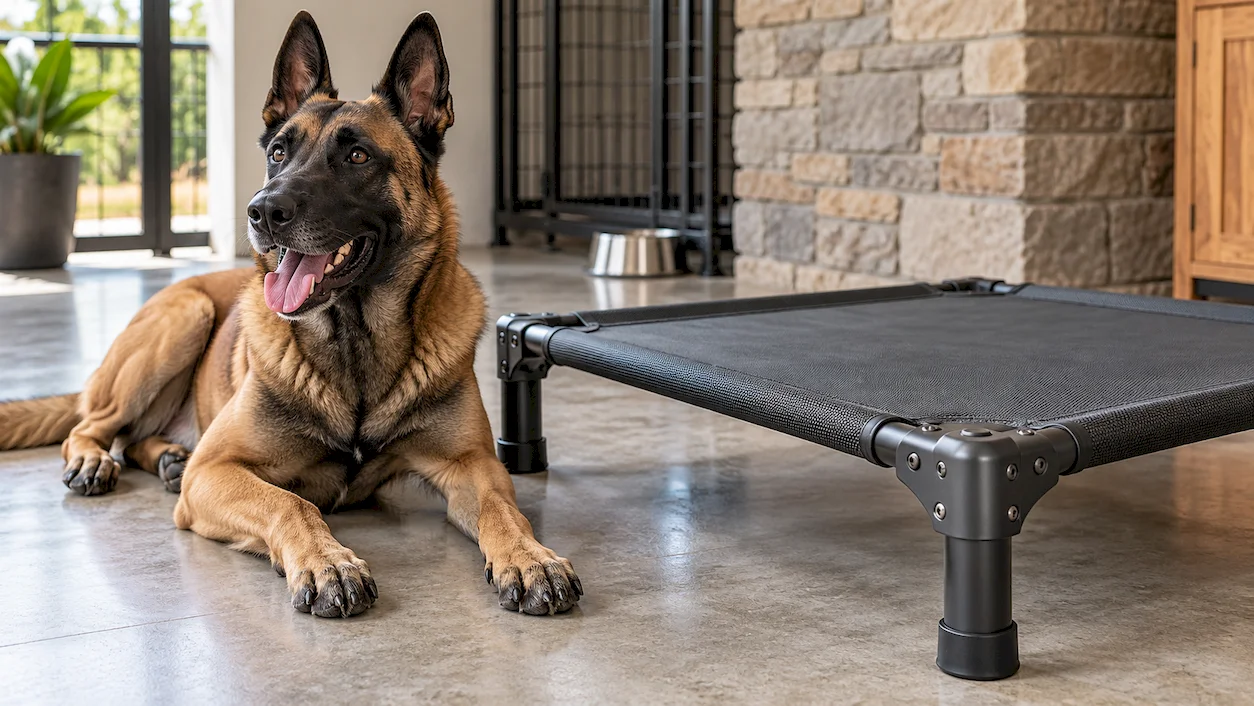
What Is an Indestructible Dog Bed?
An Indestructible Dog Bed generally refers to heavy-duty bedding engineered for dogs that chew, scratch, dig, pull, or otherwise destroy conventional beds. The term describes a durability category rather than a literal guarantee.
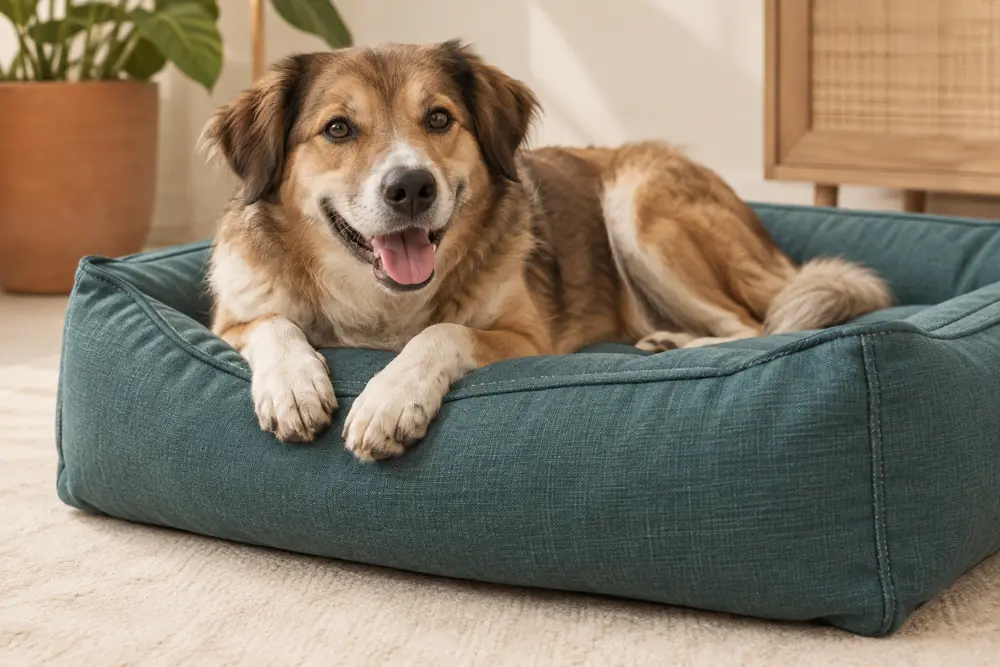
A normal plush bed may contain several vulnerable components: exposed fabric corners, piping, zipper pulls, loose covers, stitched edges, soft foam, polyester filling, and decorative attachments. Once a dog gets its teeth into one of these areas, even relatively strong fabric can become vulnerable.
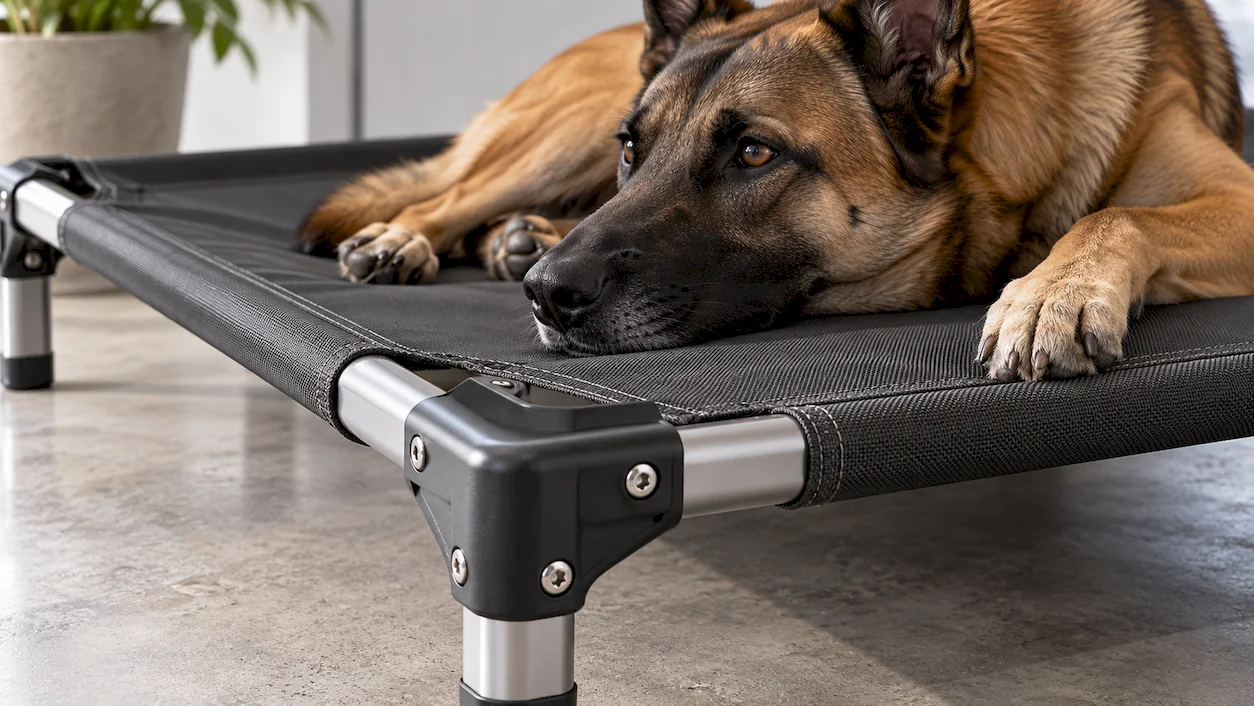
Therefore, the Most Durable Dog Bed is not necessarily the product made from the thickest textile. Product geometry matters too. For example, an elevated dog bed can stretch its sleeping surface tightly inside a frame, leaving less loose material around the perimeter for a dog to grip.
Is Any Dog Bed Really 100% Chew Proof?
No responsible manufacturer should assume that every dog will be unable to destroy a bed indefinitely. A sufficiently determined chewer may eventually damage fabric, stitching, coatings, padding, or other components.
Whole Dog Journal reached a similar practical conclusion when evaluating chew-resistant beds. Its testing emphasized that products marketed for destructive chewers still need to be matched to the individual dog’s behavior.
Instead of taking the phrase Chew Proof Dog Bed literally, buyers should compare measurable characteristics such as textile construction, exposed edges, seams, structural support, load capacity, replaceability, and warranty conditions.
| Factor | What to Examine | Why It Matters |
|---|---|---|
| Outer textile | Fiber, denier, GSM, weave and coating | Influences abrasion, tear and moisture performance |
| Frame | Aluminum, steel or reinforced polymer | Can protect vulnerable textile edges |
| Corners | Exposed textile vs. protected structure | Corners are common starting points for chewing |
| Seams | Exposed, concealed or reinforced | Loose threads can become pull points |
| Sleeping surface | Loose vs. tensioned | Tensioned fabric is harder to gather into the mouth |
| Padding | Foam or fiber access | Exposed filling can encourage further destruction |
| Load rating | Verified or manufacturer-specified capacity | Helps match construction to dog size |
| Replaceability | Cover, panel or frame components | Can extend practical product life |
| Warranty | Exact coverage and exclusions | Marketing language may differ from actual coverage |
What Makes Durable Dog Beds Different?
Effective Durable Dog Beds usually combine several design strategies. Relying on one unusually strong material is rarely enough for persistent chewers.
High-Strength Woven Fabric
Heavy-duty beds commonly use Oxford, ripstop polyester, ballistic-style nylon, or coated technical textiles. Fabric weight, yarn construction, weave, coating, and finished-product construction all influence durability.
Protected Corners
A soft corner can be placed between a dog’s molars. A protected metal corner surrounding tensioned fabric offers far less material to grip, which can make initiating damage more difficult.
Fewer Exposed Seams
Concealed closures, reinforced stress areas, simplified panel geometry, and fewer decorative components reduce potential starting points for destructive chewing.
Tensioned Sleeping Surface
Loose textile can be gathered into a dog’s mouth. A tightly tensioned panel is harder to grip and also allows elevated constructions to improve airflow underneath the dog.
Strong Structural Frame
For highly destructive dogs, aluminum or steel framing can protect textile edges and move vulnerable fabric away from common bite points.
Replaceable Components
A replaceable sleeping panel or dog bed cover can extend useful service life without requiring replacement of the complete product.
Real Commercial Specifications: 1200D Fabric and 250 lb Capacity
K9 Ballistics currently specifies 1200D ripstop ballistic polyester for its Chew Proof Armored Padded Elevated Dog Crate Bed. According to the manufacturer, the product uses a 100% aluminum frame, PU-backed textile, and a DWR finish. Its published maximum stationary load is 250 lb, approximately 113 kg.
Kuranda also specifies its aluminum dog bed for dogs weighing up to 250 lb. These figures are manufacturer specifications rather than an independent head-to-head laboratory comparison, so they should not be interpreted as evidence that different beds have identical structural performance.
Real-World Chew-Resistant Dog Bed Tests
Specifications are useful, but real-world experience can reveal weaknesses that are difficult to identify from a product sheet. The following examples are especially useful because they illustrate how construction and installation affect durability.
14 Large Dogs in a Kennel Environment
Whole Dog Journal contributor Jae Thomas reported experience with chew-resistant beds at a Malamute breeder’s kennel containing 14 dogs. According to the published account, K9 Ballistics elevated beds had remained in indoor and outdoor kennel areas for months with minimal to no visible wear.
The beds were exposed to large active dogs, rain, hosing, and strong toenails. That makes the example useful because it goes beyond a manufacturer’s product description.
However, it was not a controlled laboratory test. Dog behavior was not standardized, bite force was not measured, and abrasion cycles were not recorded. Therefore, the case should be treated as practical field evidence rather than a universal durability guarantee.
Why Crate Fit Can Affect Chewing Resistance
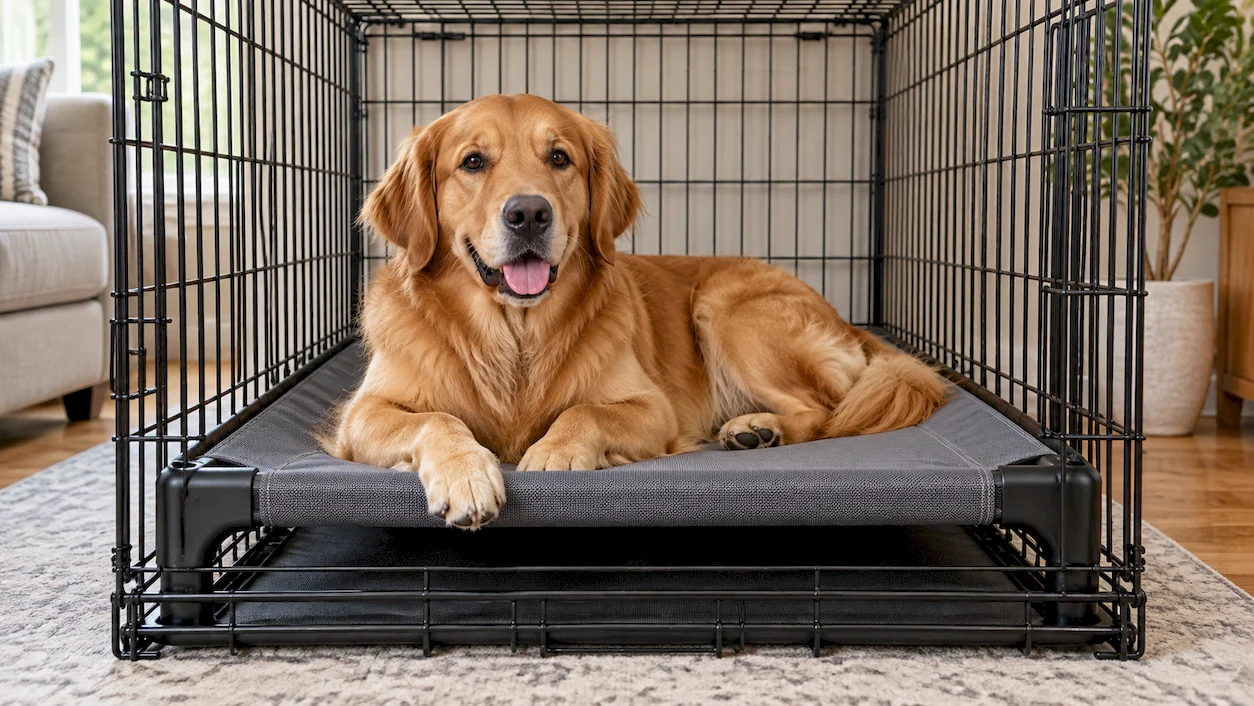
The same test highlighted another useful finding: a correctly sized elevated bed can be especially difficult for a dog to chew when installed close to the crate walls.
With little free space around the perimeter, the dog has fewer opportunities to get its mouth around an edge. This demonstrates why durability depends not only on fabric strength but also on the interaction between the Dog Bed, the dog, and the surrounding environment.
K9 Ballistics, for example, publishes a 35 × 22-inch medium bed for a 36 × 23-inch crate and a 41 × 27-inch large bed for a 42 × 28-inch crate. That close dimensional relationship illustrates how reducing accessible perimeter space can form part of the overall design strategy.
Common Mistakes When Buying an Indestructible Dog Bed
Many disappointing purchases happen because the buyer focuses on one specification while overlooking the dog’s actual destruction method.
Mistake #1: Buying the Softest “Indestructible” Bed
An extremely thick orthopedic bed may still have soft corners, accessible zippers, piping, loose textile, and foam. If the dog primarily attacks corners or searches for filling, stronger fabric may only delay the same failure.
For dogs that need joint support but are not persistent chewers, an orthopedic dog bed can still be the more appropriate choice.
Mistake #2: Looking Only at Denier
A 1200D label sounds impressive, but denier measures yarn mass rather than complete bed durability. Fiber type, weave, coating, seams, corners, and product geometry also affect how quickly damage develops.
Mistake #3: Assuming “Lifetime” Means Impossible to Destroy
Warranty language must be read carefully. Kuranda currently states that its aluminum bed supports dogs up to 250 lb and says these beds typically last more than 10 years. However, its Breathable Mesh option is specifically identified as not covered by the Chew Proof Warranty.
Mistake #4: Ignoring the Dog’s Destructive Behavior
A dog that scratches before sleeping presents a different engineering challenge from one that targets zipper pulls or deliberately opens a cover to reach foam. The correct bed should match the failure mode rather than simply carrying a “chew proof” label.
| Dog Behavior | Better Starting Point | Main Design Priority |
|---|---|---|
| Normal sleeping | General Dog Bed | Comfort and easy cleaning |
| Frequent nesting or digging | Reinforced textile bed | Abrasion resistance |
| Occasional corner chewing | Chew Resistant Dog Bed | Protected edges |
| Repeated seam destruction | Concealed-seam design | Reduce accessible stitching |
| Persistent fabric chewing | Elevated Heavy Duty Dog Bed | Tension and protected perimeter |
| Foam ingestion | Minimal or inaccessible padding | Prevent access to filling |
| Extreme destructive chewing | Metal-framed elevated construction | Structural protection |
Standard Dog Bed vs. Durable Dog Beds
Different bed constructions solve different problems. A plush bed may provide excellent comfort for a calm household dog, while a metal-framed elevated design may be more appropriate for a persistent chewer.
| Feature | Standard Plush Dog Bed | Heavy-Duty Mattress | Elevated Chew-Resistant Bed |
|---|---|---|---|
| Soft padding | High | Medium–high | Low–medium |
| Exposed textile | High | Medium | Low |
| Exposed corners | Common | Possible | Can be protected |
| Zippers | Common | Often | Often unnecessary |
| Digging resistance | Low | Medium–high | High with suitable textile |
| Chewing resistance | Low | Medium | Potentially very high |
| Ventilation | Low | Low | High |
| Foam-access risk | High | Medium | Low |
| Metal structure | No | Usually no | Often |
| Easy hose cleaning | Rare | Sometimes | Common |
| Typical use | Normal pets | Diggers/light chewers | Persistent chewers |
There is no universally superior design. For example, calming dog beds emphasize softness and security, while dog mats can prioritize portability and easy storage. Products intended for aggressive chewers require a different balance.
What Should the Best Indestructible Dog Bed Look Like?
Rather than declaring one product the universal Best Indestructible Dog Bed, it is more useful to evaluate the engineering criteria that matter for the individual dog.
What About the Best Chew Proof Dog Bed for a Crate?
Crate dimensions deserve special attention. A bed that fits closely against the crate walls can leave less accessible perimeter space for a dog to grip. Therefore, the Best Chew Proof Dog Bed for a crate should be selected according to both construction and actual crate dimensions.
For brands developing crate-specific products, this also creates an opportunity to manufacture dimensions around popular crate sizes rather than relying only on generic small, medium, and large categories.
Comfort Still Matters
Maximum chewing resistance is not necessary for every dog. Older dogs and dogs requiring greater pressure distribution may benefit more from an orthopedic dog bed, while dogs that need portable bedding may be better served by travel dog beds.
Likewise, a dog blanket may add warmth for a non-destructive dog but would generally be inappropriate as the primary durability solution for a dog that actively tears loose textiles.
How a Heavy Duty Dog Bed Is Manufactured
Making Durable Dog Beds involves much more than selecting a heavy textile. Development should begin with the expected application, dog size, destructive behavior, cleaning requirements, target lifespan, and target cost.
Material Selection
Depending on the target product, OEM options may include 600D–1200D+ woven textile options, Oxford fabric, ripstop constructions, ballistic-style polyester or nylon, PU or PVC backing, water-repellent finishes, mesh, foam, polyester filling, and aluminum or steel structures.
These figures should be treated as development options rather than automatic performance guarantees. For example, specifying “1200D” without defining seams, coating, textile weight, reinforcement, and corner construction leaves several major durability variables unresolved.
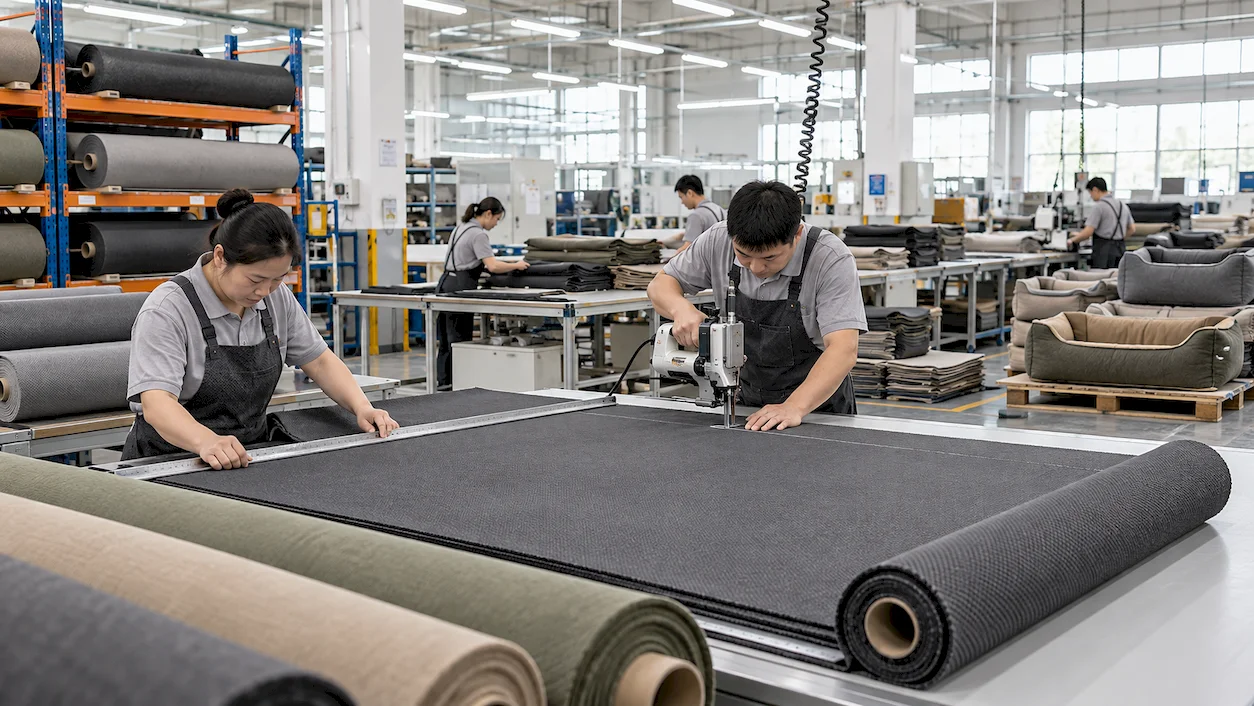
Cutting and Sewing
Accurate pattern cutting helps maintain consistent dimensions and, in elevated designs, consistent surface tension. Stitching specifications also need to match the textile because simply adding more stitches does not automatically produce a stronger seam.
Stress areas can be reinforced according to the expected load and use. Meanwhile, closures should be positioned so they do not create unnecessary bite points.

Quality Control
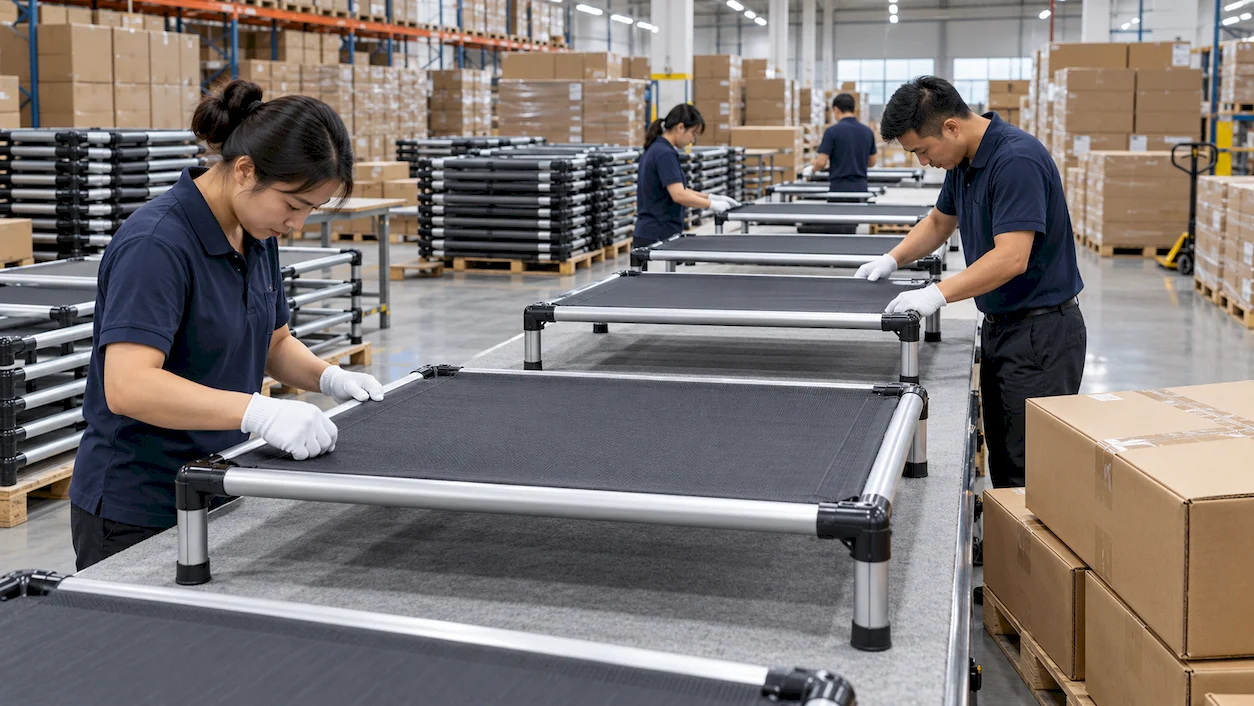
Finished-product inspection can cover dimensions, textile defects, seam consistency, loose threads, hardware, frame alignment, panel tension, coating condition, branding, and packaging.
Depending on the buyer’s specification, development programs can also incorporate abrasion, tear, seam-strength, static-load, water-resistance, or repeated-use testing. Importantly, the final product should be evaluated against its own specifications rather than adopting performance figures from another manufacturer’s bed.
Where Are Heavy-Duty Dog Beds Used?
A Heavy Duty Dog Bed is useful far beyond a household with one destructive pet. The same durability principles can benefit commercial and professional environments where beds receive frequent use and cleaning.
Elevated constructions are particularly useful when airflow and hose-down cleaning are priorities. By contrast, indoor retail customers may prefer the cushioning and furniture-like appearance of general dog beds.
OEM Indestructible Dog Bed Development
For pet brands, distributors, wholesalers, and retailers, WLVOGUE can develop an Indestructible Dog Bed concept around the intended market instead of forcing every buyer into one standard construction.
A useful OEM development process begins by identifying how the target dog is expected to damage the product. A kennel supplier targeting large working dogs may prioritize metal framing, replaceable panels, and easy cleaning. A premium household brand may instead prioritize reinforced textiles, cushioning, concealed closures, and appearance.
Example OEM Durability Brief
- Target dog
- 25–40 kg
- Primary behavior
- Digging + corner chewing
- Application
- Indoor kennel
- Cleaning
- Hose / wipe clean
- Padding
- Minimal
- Structure
- Elevated
- Priority
- Durability over plush comfort
That brief provides far more useful engineering information than simply asking for “the strongest dog bed.” Prototypes can then be evaluated for dimensions, surface tension, exposed edges, frame stability, seam construction, and textile performance before mass production.
Explore WLVOGUE OEM ManufacturingFrequently Asked Questions
No fabric Dog Bed can realistically be guaranteed against every dog forever. However, a well-engineered Indestructible Dog Bed can be dramatically harder to damage than conventional plush bedding.
Metal-framed elevated beds are among the strongest common designs because the frame can protect vulnerable edges while keeping the sleeping textile under tension. The appropriate construction still depends on the individual dog’s behavior.
There is no universal winner. Persistent chewers generally benefit from protected edges, limited accessible padding, strong framing, and tensioned fabric. Diggers and moderate chewers may benefit more from a reinforced padded design.
The Best Chew Proof Dog Bed is one matched to the dog’s destructive behavior. A dog that targets zipper pulls requires a different construction from one that digs continuously or grabs bed corners.
No. Commercial heavy-duty beds use 1200D textiles, but denier alone cannot make fabric chew proof. Fiber, weave, coating, seam construction, reinforcement, and edge accessibility also affect durability.
There is no single most durable material for every application. Metal frames combined with strong technical textiles are common in extreme-duty products, while ballistic-style polyester or nylon, ripstop, and coated Oxford fabrics are common textile options.
Yes. However, maximum durability and maximum cushioning can compete with each other. Thick padding improves comfort but also creates additional material that may become accessible if a destructive dog breaches the outer layer.
OEM development can cover textiles, dimensions, reinforcement, padding, frame construction, colors, branding, labels, and packaging. Specifications should be selected according to dog size, destructive behavior, use environment, and target price.
So, Are There Any Indestructible Dog Beds?
Yes, but “indestructible” should be understood as a durability category rather than an absolute promise. Real-world experience shows that carefully designed beds can withstand demanding use, while commercial products demonstrate that heavy-duty construction can combine technical textiles with substantial structural capacity.
The Most Durable Dog Bed is rarely just a thicker version of an ordinary bed. For serious chewers, effective designs focus on the complete system: strong textile, protected edges, limited exposed seams, appropriate surface tension, structural support, and consistent quality control.
For pet brands developing private-label products, the same principle applies. Instead of trying to manufacture a literally impossible-to-destroy product, WLVOGUE can develop a Chew Resistant Dog Bed, Chew Proof Dog Bed, or Heavy Duty Dog Bed around measurable durability requirements, comfort, cleaning needs, price positioning, and the intended sales channel.